



Gold trading involves buying or selling gold, or opening positions in financial instruments linked to its price, to benefit from upward or downward price movements. The method of trading depends on the instrument used and whether it gives you ownership of physical gold or simply exposure to price changes.
Gold trading methods include spot gold, futures, CFDs, and gold ETFs. On many trading platforms, gold is quoted against the US dollar under the symbol XAU/USD. These instruments differ in actual ownership, costs, leverage, and settlement method. Some let you own gold or investment units, while others provide exposure to price movements without ownership of the metal.

Top Broker of the Month
Open an Exness account and practice trading with a resettable $10,000 demo — zero risk to your own money.
Table of Contents
How Does Gold Trading Work?
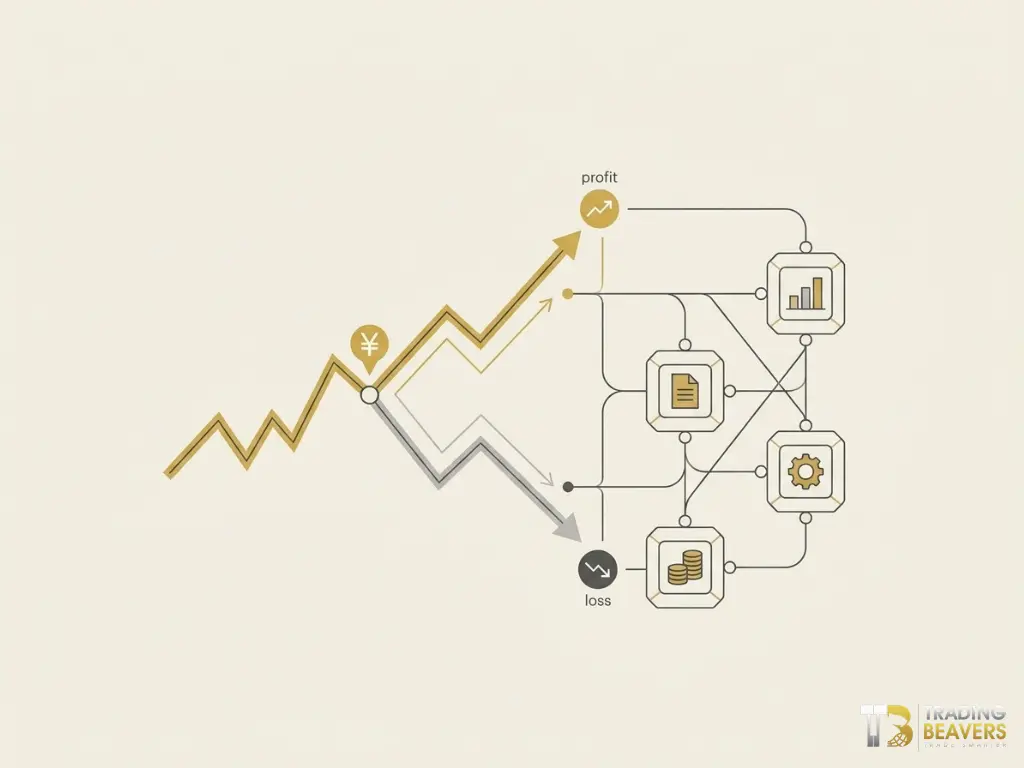
The outcome of a gold trade depends on the difference between the entry and exit prices and whether the position is long or short. Profit or loss is determined by the amount of exposure to gold and the trading costs. Leverage affects the margin required to open the position, but not the value of a price move itself when the position size stays the same.
Example of Gold Price Movement
Suppose you open a long position equivalent to one ounce of gold at a hypothetical price of $4,500. If the price rises to $4,550, your theoretical profit is $50 before costs. If it falls to $4,450, your theoretical loss is $50 before costs.
| Exit Price | Price Change | Result for a One-Ounce Long Position |
|---|---|---|
| $4,550 | +$50 | $50 profit |
| $4,450 | −$50 | $50 loss |
This example does not mean that opening a position equivalent to one ounce necessarily requires a $4,500 deposit. The amount required varies depending on the instrument, margin, and leverage, while the notional exposure in this example remains $4,500.
You can estimate the outcome of a trade by multiplying the price difference by the number of ounces represented by the position, then accounting for trading costs. The actual calculation depends on the contract specifications and account currency.
Other factors also affect the actual outcome:
- Position size: The amount of gold or the value of your market exposure.
- Instrument type: For example, spot gold, futures, or CFDs.
- Leverage: Determines the margin required to open a position and can amplify profits and losses relative to the capital used.
- Trading costs: Such as the spread, commission, and financing or overnight costs, where applicable.
What Does XAU/USD Mean?
XAU/USD is the symbol used to quote gold against the US dollar. XAU stands for gold, while USD stands for the US dollar.
If XAU/USD = 4,500, this means that one ounce of gold is worth about 4,500 US dollars according to the instrument displaying that price. So, a rise in the pair means gold has risen against the US dollar, while a fall means gold has declined against the US dollar.
Spot gold refers to gold transactions conducted at prevailing market prices, with settlement following the conventions of the spot market. The spot gold price is used as a reference for pricing many financial products. However, what some retail broker platforms list as Spot Gold or XAU/USD may be a contract for difference (CFD) that tracks the price, rather than an actual purchase of gold. The nature of the product and the trader’s rights therefore vary by broker and contract.
So, before opening a trade, check the instrument type, contract size, settlement method, leverage, spread, commissions, and other costs, rather than relying on the XAU/USD name alone.
What Is the Difference Between Gold Trading and Gold Investing?
The main differences between gold trading and gold investing are their objectives, holding periods, trading frequency, and methods of gaining exposure to gold.
| Factor | Gold Trading | Gold Investing |
|---|---|---|
| Goal | Benefit from price movements | Long-term holding and exposure |
| Time Horizon | Usually short to medium term | Usually longer term |
| Number of Trades | Relatively higher | Usually lower |
| Instruments | Spot, futures, CFDs, and others | Gold bars, gold coins, ETFs, and others |
| Leverage | May be used, depending on the instrument | Not necessary |
| Monitoring | More frequent | Usually less frequent |
A gold trader typically focuses on price action over shorter periods, from minutes or hours to days or weeks. As a result, they pay more attention to entry and exit timing, the trend, volatility, news, and position management.
A gold investor typically maintains exposure to gold for longer. Their goal may be portfolio diversification, holding an asset different from stocks and bonds, or gaining long-term exposure to the gold price.
Long-term investing does not mean that gold is low-risk or that it always rises during crises. Its price can rise or fall for extended periods depending on interest rates, the dollar, inflation, market expectations, and demand for gold.
In short: Trading focuses more on price movements and trade timing, while investing focuses on maintaining exposure to gold over a longer period. If your goal is long-term investing, see the best ways to invest in gold to compare suitable options.
How Can You Trade Gold?
There are several ways to gain exposure to gold price movements, but they do not all provide ownership of the gold itself or work in the same way. Instruments differ in ownership, liquidity, costs, leverage, and risk.
Some of the main ways to trade gold and gain exposure to its price include:
Physical Gold
Buying physical gold means owning actual gold bars or coins and holding them directly or with a specialized storage provider. The purchase price often differs from the global spot price because of manufacturing and distribution premiums. When you sell, your return depends on changes in the price of gold and the difference between the buy and sell prices, as well as storage and insurance costs, if applicable. This approach is generally suited to those who want to own the metal itself rather than actively trade its price movements.
Gold CFDs
Gold CFDs let you trade price movements without owning the metal; the difference between the price when you open and close the position is settled in cash. You can go long if you expect the price to rise or go short if you expect it to fall. Your actual exposure is determined by the position size and contract specifications, while leverage affects the required margin and can amplify profits and losses relative to the capital used.
Gold ETFs
Gold ETFs provide exposure to the price of gold by letting you buy units traded on an exchange, without having to store gold yourself. You own units in the fund, not specific bars, and this does not necessarily give you the right to receive physical gold. Fund structures vary: some are backed by physical bars, while others use different structures. Check the fund prospectus to learn about its structure, custody and redemption policies, and management fees.
Gold Futures
Gold futures are standardized contracts traded on regulated exchanges. They specify the quantity of gold, delivery or settlement terms, and the contract’s expiration month. Some contracts are settled through physical delivery and others in cash. Traders therefore need to monitor the expiration date, margin requirements, and settlement method, and decide whether to close their position or roll it over to a later contract before expiration, in line with the contract specifications and the broker’s policy.
Gold Mining Stocks
Buying gold mining stocks gives you indirect exposure to the gold market because a company’s revenue and profitability may be affected by the price of the metal. But a stock’s price does not depend on gold alone; it is also affected by production costs, debt, management, and operational and political risks. The company may also pay dividends to shareholders.
The following table summarizes the key differences between these methods:
| Method | Usually Suitable for | Main Advantage | Main Drawback |
|---|---|---|---|
| Physical Gold | Long-term holding | Physical ownership of the metal | Storage and the spread between buying and selling prices |
| CFDs | Active trading | Ease of trading and access to leverage | Leverage risks and financing costs |
| Gold ETFs | Exchange-traded investing | Easy to trade, with no need for storage | Fees and lack of direct ownership of gold bars |
| Futures | Trading and hedging | Regulated trading and liquidity in the main contracts | Complex margin requirements and expiration dates |
| Mining Stocks | Indirect exposure to gold | Potential to benefit from company performance | Operational risks not tied to gold alone |
The most important question to ask before choosing a way to trade gold is: What do I actually own or trade? Owning a gold bar differs from owning an ETF unit, and both differ from trading a CFD or a futures contract tied to the price of gold.

What Factors Affect the Price of Gold?
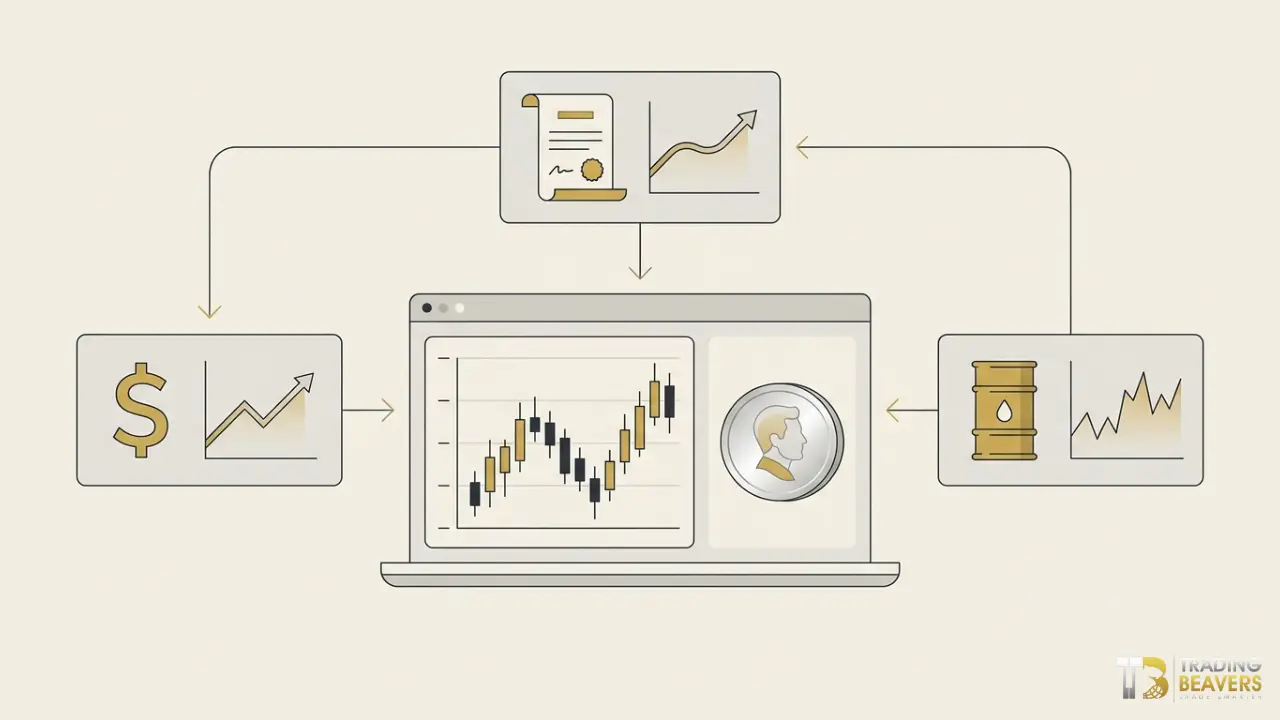
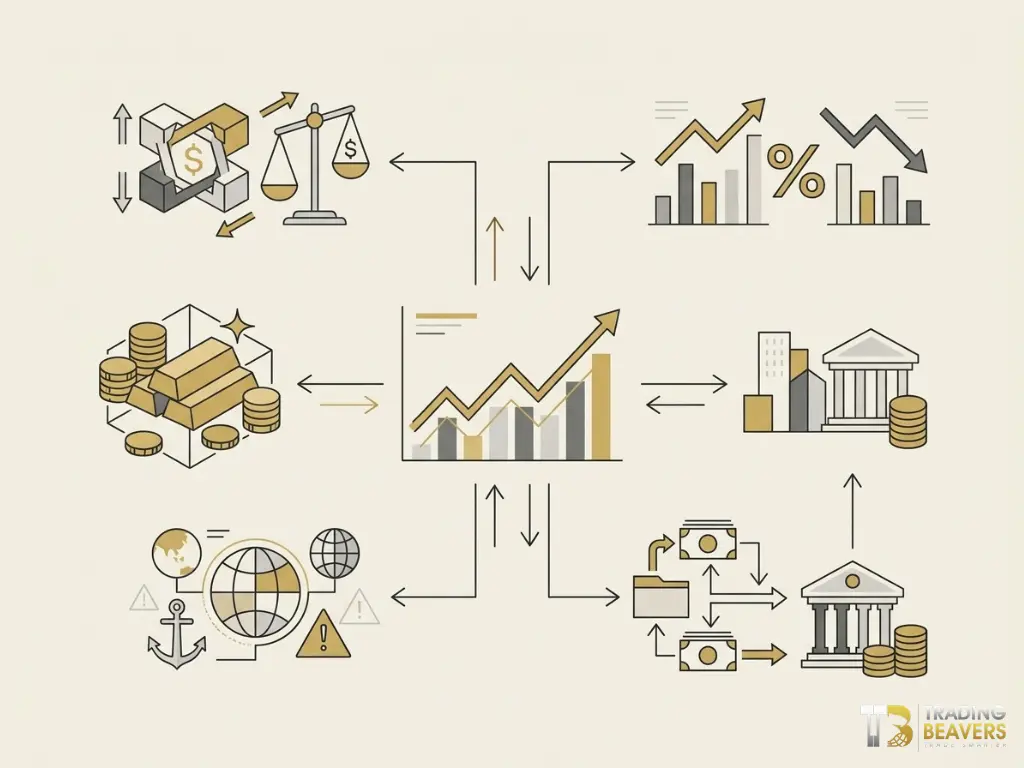
The price of gold is affected by several factors, most notably the US dollar, interest rates and real yields, economic and geopolitical risks, investment demand, and central bank purchases. None of these factors acts alone or has a consistent relationship with gold at all times, so gold’s response can vary with market conditions.
US Dollar
Gold is linked to the US dollar because it is priced globally in that currency. As a result, a weaker dollar may support the price of gold by making it relatively less expensive for buyers using other currencies, while a stronger dollar may weigh on the price.
Interest Rates and Real Yields
Gold itself does not pay interest or generate regular income, so real yields—that is, yields after accounting for expected inflation—affect its appeal relative to income-producing assets. Lower real yields may support demand for gold, while higher yields increase the opportunity cost of holding it. That is why traders monitor central bank decisions, interest rate expectations, and bond yield movements.
Economic and Geopolitical Risks
Demand for gold may increase during economic crises, geopolitical tensions, and market disruptions, as some investors use it to diversify or as an asset that is sometimes viewed as a safe haven.
Investment Demand and Central Bank Purchases
Investment demand affects the gold market through gold funds, bars and coins, and other investment instruments. Central bank purchases can also affect demand, particularly when reserve management and diversification strategies change.
Monitoring investment flows and central bank purchases can therefore help you understand some of the drivers of demand for gold, alongside economic and financial factors. For more detail on the global gold market and how it works, read the dedicated article.

When Can You Trade Gold?
Gold trading hours vary by instrument, market, and broker, so there is no single trading schedule that applies to all gold products.
For example, standard Gold (GC) and Micro Gold (MGC) futures contracts trade electronically on CME/COMEX for approximately 23 hours a day during the trading week, with a daily trading break. Some other gold products may follow different schedules. You can check the latest schedules on the official contract specifications page on the CME Group website.
For Spot Gold and CFDs offered by retail brokers, trading hours depend on the product, broker, and liquidity provider. They may also change during holidays or maintenance periods.
So, before placing a trade, check the instrument’s trading hours on your platform, the time zone used, any breaks, and the broker’s or exchange’s holiday schedule.
How to Analyze Gold Before Trading
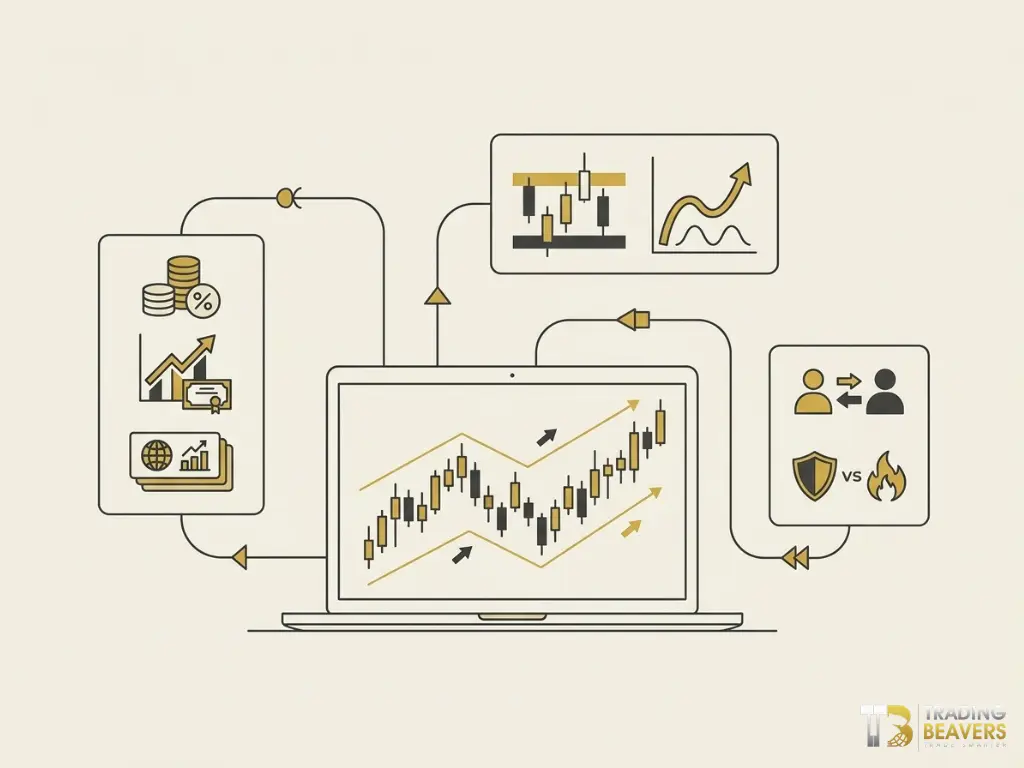
You can analyze gold before trading by combining fundamental analysis, technical analysis, and market sentiment analysis. None of these methods provides a guaranteed forecast of price action, so traders use them to build a trade scenario and define risk—not to predict the future trend with certainty.
Fundamental Analysis of Gold
Fundamental analysis focuses on economic and financial factors that can change market expectations for gold.
Rather than looking at the dollar, interest rates, or inflation in isolation, traders try to understand how new data affects expectations for interest rates, yields, the dollar, and demand for gold.
Events that receive particular attention include central bank decisions, inflation and employment data, changes in real yields, and economic and geopolitical events.
Technical Analysis of Gold
Technical analysis focuses on price action itself to help identify the trend and potential entry and exit areas, while supporting risk management.
Traders may use tools such as support and resistance levels, trendlines, moving averages, momentum indicators, Average True Range (ATR), and price action.
But technical indicators cannot reliably predict gold price movements. They help traders interpret what has happened to the price and develop a possible scenario for what may happen next.
Market Sentiment Analysis
Market sentiment analysis focuses on how investors interpret information and position themselves before and after it is released.
For example, inflation data may come in high, but if it is below market expectations, gold may move differently than the figure alone might suggest.
So it is not enough to ask, What did the data show? You should also consider: How did it compare with what the market expected?
In practice, traders can use fundamental analysis to understand why gold moved, technical analysis to identify entry and exit zones and manage the trade, and market sentiment to understand how investors are reacting to new information.
How to Start Trading Gold
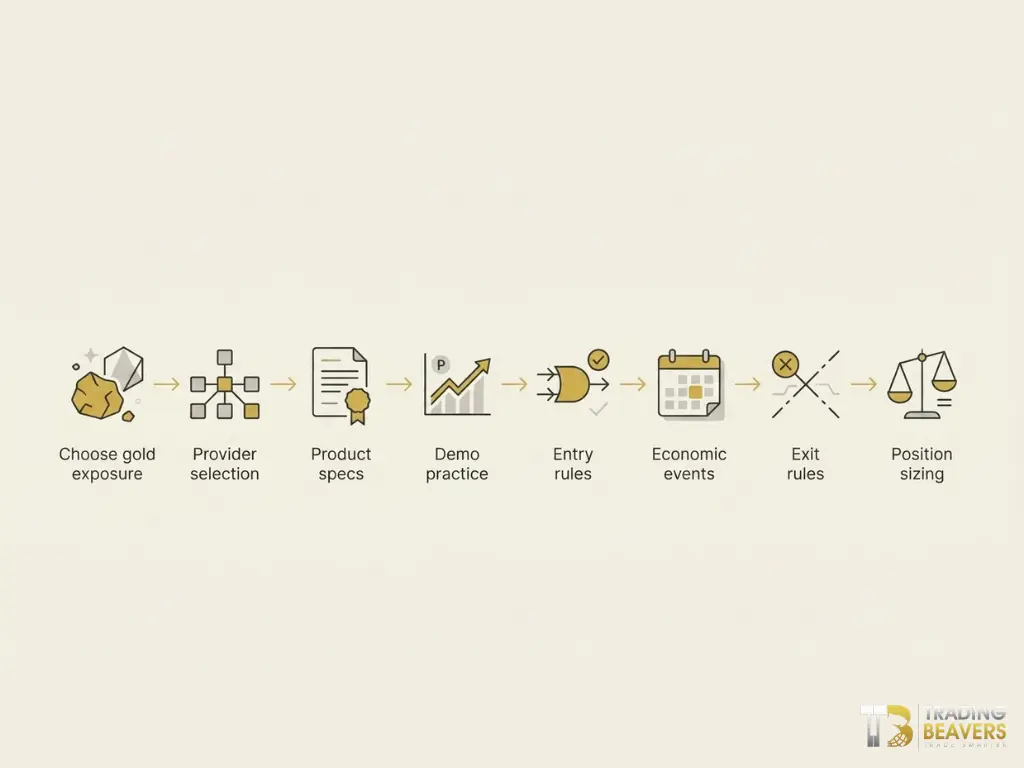
To start trading gold in a structured way, first choose the instrument you will use, then select a trading provider, understand the product specifications, and create a plan that defines your reason for entry, your risk, and your position size before placing any trade.
1. Choose How to Get Exposure to Gold
Start by choosing the instrument that suits your goal, such as physical gold, an ETF, futures, a CFD, or mining company stocks. These instruments differ in ownership, costs, liquidity, leverage, and risks.
2. Choose a Suitable Broker or Trading Provider
If you plan to trade gold through a broker, choose a licensed provider that offers the instrument you selected in the first step. Before opening an account, make sure the broker is overseen by the relevant regulator and that its trading costs, account terms, and order execution policy are clear.
3. Understand the Instrument’s Specifications Before Trading
Before opening your first trade, review the instrument’s specifications: contract size, margin, leverage, costs, and trading hours. Contract size and position size determine your actual market exposure, while leverage affects the margin required to open the position.
4. Practice on the Trading Platform
You can use a demo account to learn how orders are executed, use stop-loss and take-profit orders, choose a position size, and monitor margin. But demo account results do not guarantee the same results when trading with real money, because psychological pressure and actual execution conditions may differ.
5. Set Clear Entry Rules
Decide in advance what will prompt you to enter a trade, whether it is based on the price trend, support and resistance, price action, economic data, or a strategy that combines more than one factor. Do not base your entry decision solely on the belief that gold will rise or that the price has fallen significantly.
6. Review Events That Could Affect the Trade
Before entering, check the economic calendar for events that could increase gold’s volatility, such as interest rate decisions, inflation data, and employment data. This step is especially important for short-term trading or when holding a trade through news events.
7. Set an Invalidation Point for Your Analysis and an Exit Plan
Before opening the trade, ask: At what price level would the rationale for entering no longer be valid?
Use this level to determine how you will manage a loss. Then decide in advance when you will exit if the price moves against you, where you could take profits if it moves in your favor, and how you will respond to changing market conditions. Having an exit plan before entering helps reduce impulsive decisions as the price moves.
8. Determine Position Size
Determine the position size based on your capital, the distance to your exit level, and the amount you are willing to lose if gold moves against you. Do not choose your position size based on the maximum leverage available on your account; the available leverage alone does not determine an appropriate level of risk.
How Do You Choose a Gold Trading Broker?
To choose a gold trading broker, first decide which instrument you want to trade, then compare brokers based on licensing and legal entity, product type, contract specifications, costs, leverage, and execution quality.
Check the Broker’s Licensing and Legal Entity
A broker’s name recognition is not enough; check which legal entity your account will be opened with and whether it is regulated by the relevant authority. Verify the license number in the regulator’s own official register (such as the FCA, CySEC, ASIC, or DFSA register, depending on the entity), not just on the broker’s website.
The same brand may operate through multiple entities in different countries, so regulatory protection, leverage, products, and account terms may vary depending on your country of residence and the entity that serves your account.
Know Which Gold Product You Will Trade
Check what kind of product the broker offers, such as CFDs, futures, ETFs, or mining stocks. Do not rely only on seeing the word Gold or the symbol XAU/USD; the symbol does not necessarily identify the type of contract or whether you own the underlying gold.
Review the Contract Specifications and Leverage
Check the contract size and minimum trade size, the value of a price movement, margin requirements, leverage, and Margin Call and Stop Out levels. Contract size and position size determine your actual exposure, while margin and leverage determine the capital required to open the position.
Compare the Total Cost of Trading
When comparing brokers, don’t rely on the spread alone. Also review commissions, financing or overnight costs, deposit and withdrawal fees, currency conversion fees, and any other account-related fees. Actual costs may vary depending on the account type, position size, and how long you hold the position.
Understand the Broker’s Order Execution Policy
Review how the broker executes orders, especially during news events, fast-moving markets, and periods of low liquidity. It’s important to understand the broker’s policy on slippage, execution of stop-loss orders, and execution speed, because the actual execution price may differ from the expected price in volatile market conditions.
Test the Platform Before Trading Live
Try the broker’s trading platform using a demo account, as you would during practice, but focus here on order execution quality, clear specifications for the gold instrument, and how easy it is to monitor margin.
After reviewing these criteria, you can compare the best gold brokers based on licensing and legal entity, product type, costs, and actual trading conditions.
Best Gold Brokers
The best gold brokers depend on the instrument you want to use, your country of residence, and your trading approach. A trader looking for CFDs needs different criteria from an investor who wants to trade gold ETFs or mining stocks.




What Are the Risks of Gold Trading?
Gold trading carries risks that vary depending on the instrument and strategy used. Risks can be especially high when using leveraged products or trading during periods of sharp volatility.
- Price volatility: Gold can move sharply over short periods, so describing it as a safe haven does not mean its price is always stable.
- Leverage: Leverage can magnify gains and losses, so focus on your actual exposure, not just the required margin.
- News risk: Important data releases and events can cause slippage, wider spreads, and sharp price moves.
- Instrument risk: The risks of a CFD differ from those of futures, ETFs, and physical gold, so you should understand the product itself before trading.
- Counterparty risk: This is particularly relevant for some over-the-counter (OTC) products, where you depend on the broker or product provider.
- Holding costs: These include financing or swap charges, fund fees, rollover costs, and storage fees, and may affect the trade’s final result.
To manage these risks in practice, set an invalidation point for your analysis, an exit plan, and your position size before opening a trade. If you have several correlated trades, monitor your total market exposure.
You can risk a set percentage of your capital on each trade, but there is no single percentage that suits all traders or strategies. Using a stop-loss can help manage losses, but it does not guarantee execution at the specified price in fast-moving markets.
Checklist Before Opening a Gold Trade
Before clicking the button to place your trade, review this quick checklist:
- Do I know what type of product I’ll be trading and how it is settled?
- Have I checked the legal entity offering the product and its regulatory status?
- Do I know the contract size, the value of a price move, and the required margin?
- Have I calculated the trade’s total cost?
- Have I identified my reason for entering, the point that would invalidate my analysis, and my exit plan?
- Have I set my position size so I can absorb a potential loss without affecting my financial obligations?
If Sharia considerations matter to you, also check the nature of the instrument and contract, as well as the associated costs. The absence of overnight interest alone does not mean a product is Sharia-compliant.
The most important question before trading gold isn’t Where will the price go tomorrow? It’s What instrument am I trading, how much exposure do I have, and how much could I lose if my expectation is wrong?
Frequently Asked Questions About Gold Trading
What Is a Gold Ounce?
A gold ounce is a troy ounce, equal to about 31.1035 grams. It is used worldwide as a standard unit for pricing gold and differs from the ordinary ounce used in some weight measurements.
How Much Capital Do I Need to Start Trading Gold?
There is no fixed amount required to start trading gold. The capital you need depends on the instrument, contract size, margin, and broker’s terms. More important than the minimum deposit is having enough capital to manage risk and absorb potential losses without affecting your essential financial obligations.
Is Gold Trading Suitable for Beginners?
Beginners can learn the basics of gold trading, but the level of complexity and risk varies across instruments. Owning physical gold or units in some gold funds differs from trading leveraged contracts, which requires a greater understanding of margin, position size, and how to manage losses.
Is Gold Trading Profitable?
Gold trading can generate profits, but it also carries the risk of losing capital. Results depend on price movements, position size, costs, trading strategy, and risk management; no method guarantees consistent profits.
📌 Disclaimer: This content is for educational and informational purposes only and does not constitute investment advice. Trading involves high risks that may result in the partial or total loss of capital. You should conduct your own research before making any investment decision.