



Top Broker of the Month
Open an Exness account and practice trading with a resettable $10,000 demo — zero risk to your own money.
Learning to trade from scratch starts with understanding how financial markets work, what you trade, and how prices move, followed by learning to execute buy and sell orders and apply risk management before using real money.
Learning to trade does not mean searching for a stock or currency that will rise tomorrow. It means building knowledge gradually so you can understand the market, choose the right financial product, calculate the cost of a trade, and determine how much of a loss you can tolerate if the price moves against your expectation. No strategy or indicator can guarantee a profit; trading always involves the possibility of a loss.
At first, you may feel that there’s a lot of scattered information, so we’ve laid out an 11-step path in this guide, starting with the basics and ending with a gradual transition to a live account. You can then explore each stage in more depth through the site’s trading lessons.
Table of Contents
What Is Trading?
Trading is buying and selling a financial asset, or opening a position to benefit from changes in its price, with the goal of generating a financial return from market movements. Trading can involve different markets and assets, including stocks, forex, gold and commodities, indices, cryptocurrencies, contracts and financial derivatives.
But trading does not necessarily mean owning the asset itself. When you buy an actual stock, you may gain an ownership stake in the company. When you trade a contract for difference (CFD), however, your result is tied to changes in the asset’s price, usually without owning the underlying asset.
So before placing any trade, it is important to know what asset you are trading, which financial product you are using to trade it, and whether it gives you actual ownership or only exposure to price movements.
What Is the Difference Between Trading and Investing?
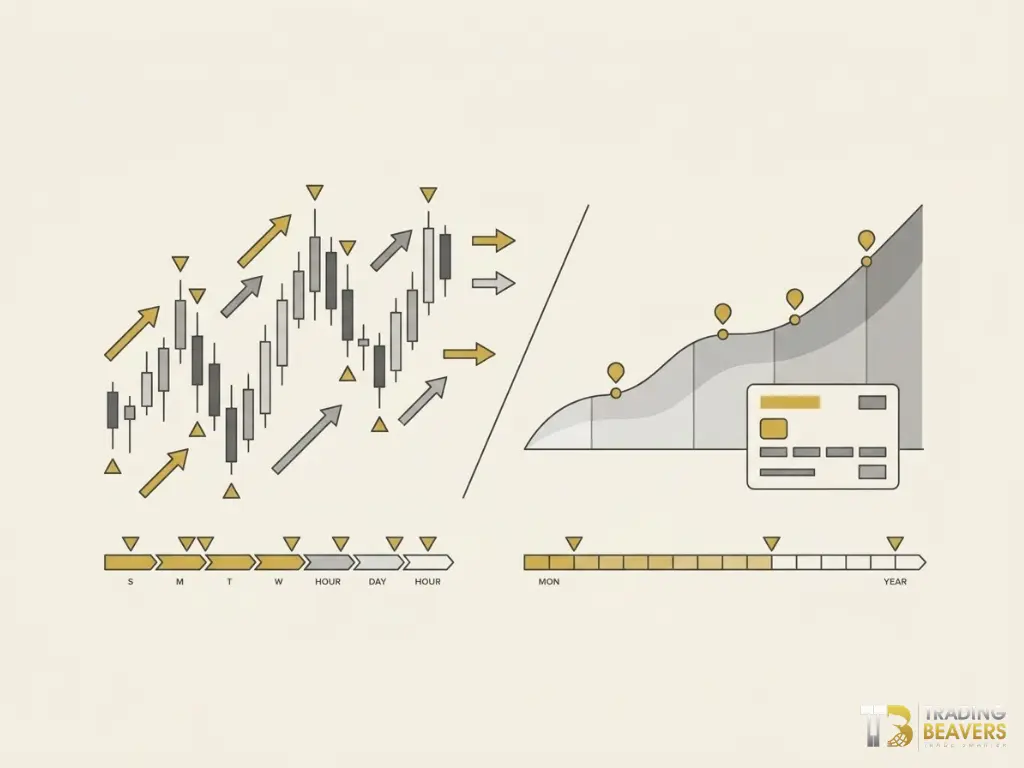
The main difference between trading and investing lies in how you approach the asset, the time frame, and the goal. Trading typically focuses on benefiting from price movements over shorter periods, while investing generally involves holding an asset for longer to benefit from its growth in value or returns over time.
| Factor | Trading | Investing |
|---|---|---|
| Time frame | Usually short or medium term | Typically longer term |
| Number of trades | Usually more | Usually fewer |
| Focus | Price action and execution | Asset value and outlook |
| Monitoring | More regular | Usually less frequent |
| Technical analysis | Common | May be less important |
| Transaction costs | May recur when trades are frequent | Usually recur less often |
A longer holding period does not mean an investment is risk-free, just as short-term trading does not guarantee profits. The outcome depends on the type of asset, market conditions, strategy, amount of capital, risk management, and costs.
How to Learn to Trade From Scratch, Step by Step
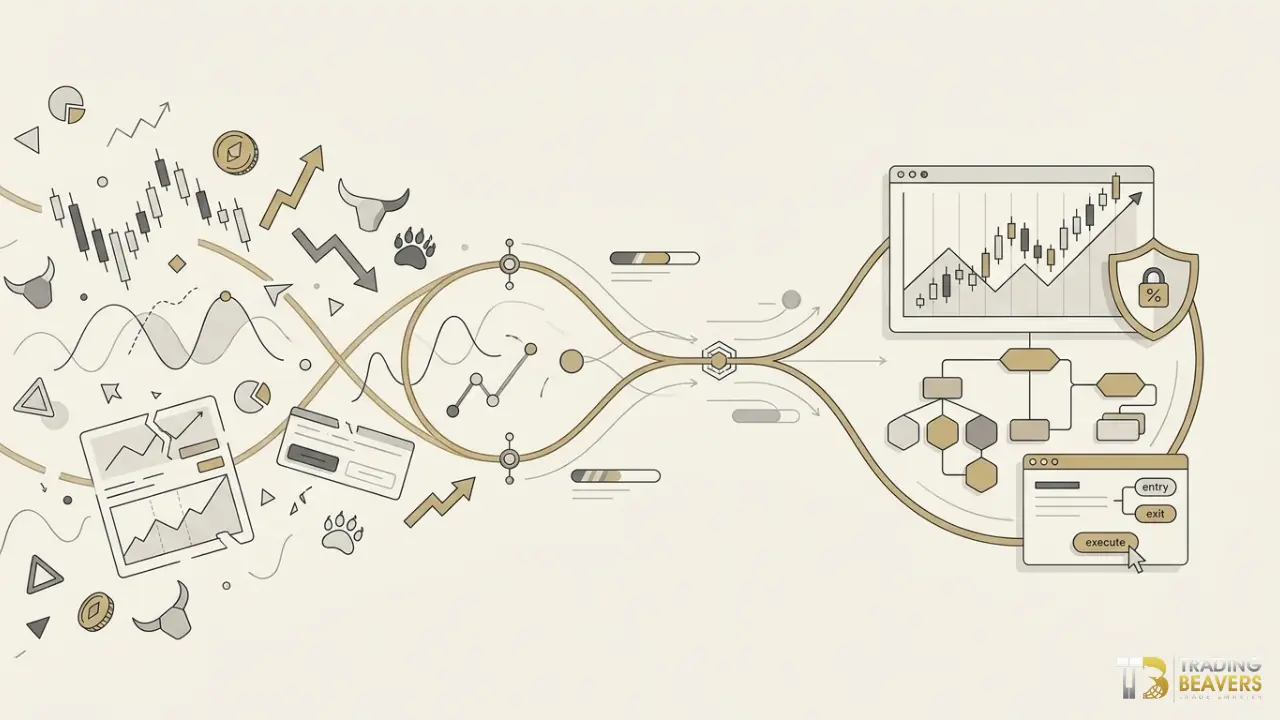
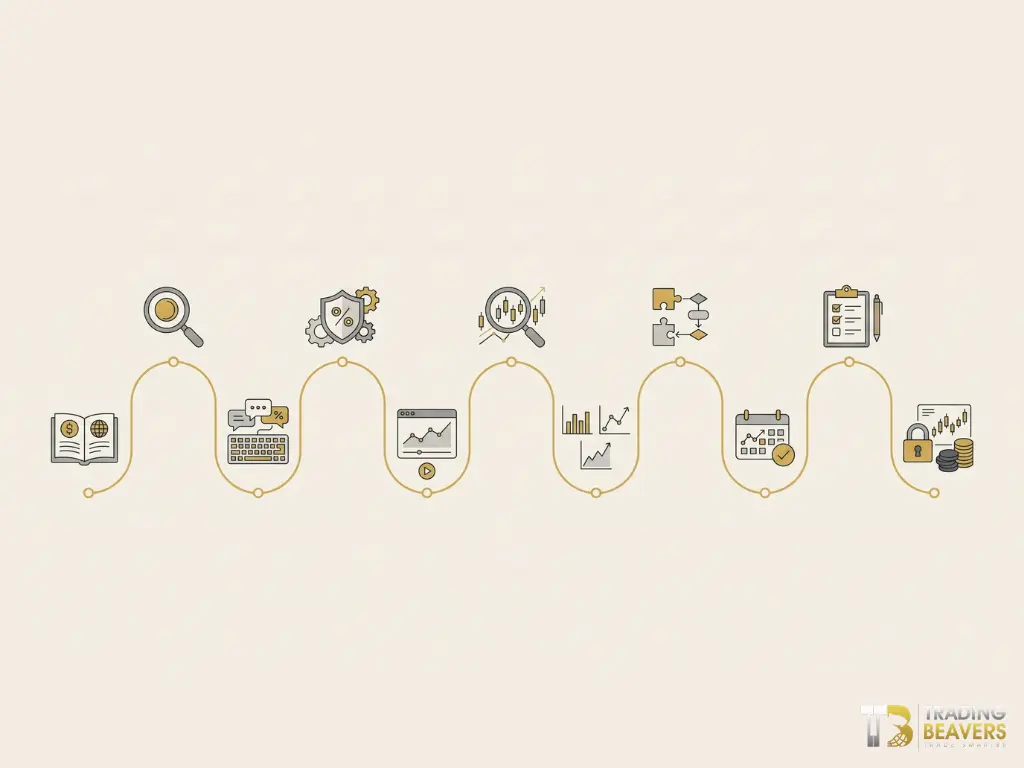
To learn to trade, follow a gradual, structured path that starts with understanding how markets work and the basics of trade execution and risk management, then moves on to analysis, building a trading strategy, and testing it in a demo account before risking real money. This path can be divided into 11 practical steps:
1. Understand What Trading Is and How Financial Markets Work
Before opening a trading platform or placing your first trade, start by understanding how the market works. At this stage, learn:
- How do buying and selling work?
- Why do prices move?
- Who participates in the market?
- What does liquidity mean?
- What is volatility?
You do not need to memorize dozens of indicators or strategies at the outset. Understanding how the market works, what drives prices, and the product you are trading matters more than searching for a ready-made strategy.
2. Choose One Market to Learn First
One of the most common mistakes when learning to trade from scratch is trying to study forex, stocks, gold, and cryptocurrencies all at once.
It is better to choose one market at first, because each market has different characteristics, including trading hours, factors that affect prices, liquidity, volatility, terminology, and available products. You can find a brief comparison of the main markets in the financial markets section below.
Start by understanding how your chosen market works, what moves its prices, when it trades, and what risks are involved. Then gradually expand your knowledge to other markets once you have mastered the basics.

3. Learn Basic Trading Terms
Before placing your first trade, learn basic trading terms that you will use when opening and managing trades and calculating their costs.
- Market order: An order to execute a trade immediately at the best available market price. It does not guarantee the execution price.
- Limit order: An order to buy or sell an asset at a price set in advance or better. It does not guarantee execution if the price does not reach that level.
- Stop order: An order that is activated when the price reaches a certain level and usually becomes a market order at that point.
- Stop-loss: An order that automatically closes a trade if the price moves against your expectations, with the goal of limiting the loss. However, during gaps or rapid price movements, it does not guarantee an exit at the specified price.
- Take-profit: An order that automatically closes a trade when the target profit level is reached.
- Bid / Ask: The bid is the highest price buyers are offering, at which you can sell. The ask is the lowest price sellers are asking, at which you can buy.
- Spread: The difference between the ask and bid prices, which may be part of the cost of trading.
- Commission: A fee a broker may charge for executing a trade.
- Leverage: Leverage lets you control a position larger than the capital you put up, but it magnifies potential profits and losses.
- Margin: The amount of your account balance that you must set aside to open a trade using leverage.
- Liquidity: How easily an asset can be bought or sold without significantly affecting its price.
- Volatility: The extent and speed of an asset’s price movements over a given period.
The additional terms vary by market. In forex, you’ll need to understand pips, lots, and currency pairs. In stocks, you’ll encounter concepts such as market capitalization, earnings per share, and dividends. Cryptocurrencies require an understanding of networks, wallets, storage methods, and tokenomics.
4. Learn Risk Management Before Looking for Profits
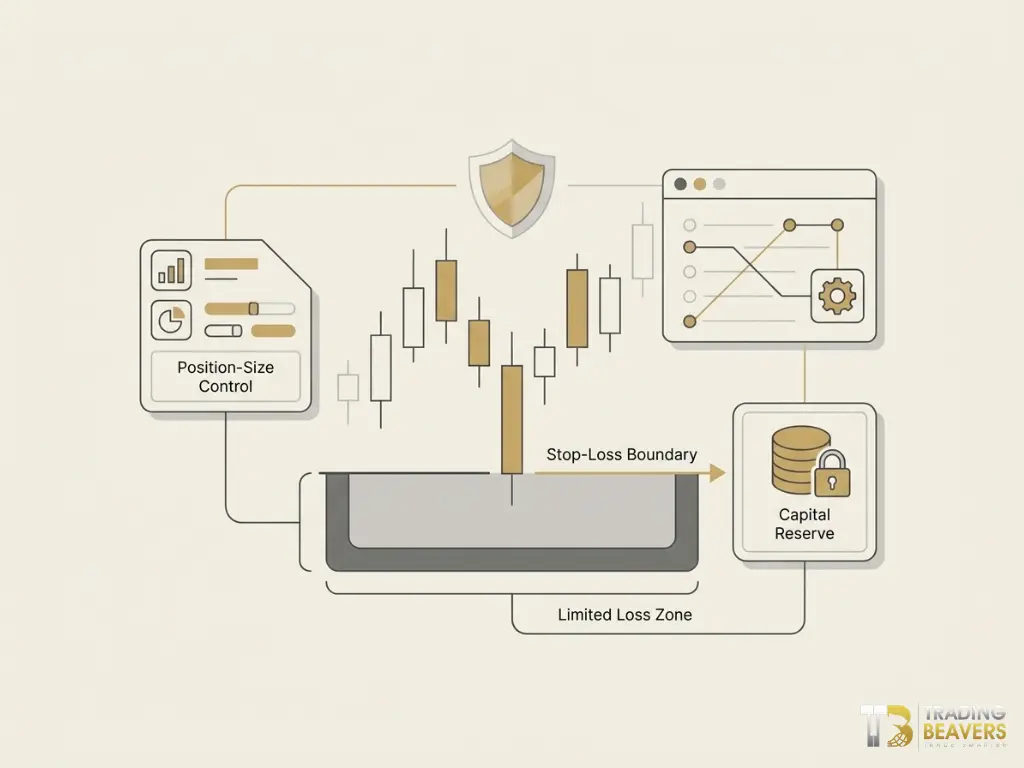
Risk management in trading means determining how much you could lose before opening a trade, rather than thinking only about profit. So before asking, How much can I make?, first ask, How much could I lose if the market moves against me?
Before placing any trade, clearly define:
- Position size: The trade size appropriate for your capital and risk tolerance.
- Stop-loss level: The price you set to trigger an exit order if the market moves against you. The actual execution price may differ from this level.
- Planned risk per trade: The amount or percentage you intend to risk based on the position size and stop-loss level. Your actual loss may exceed this amount because of slippage, price gaps, or trading costs.
- The effect of leverage: Leverage can magnify losses as well as potential profits.
Hypothetical example: Suppose your account balance is $2,000 and you decide not to risk more than 1% on any one trade, or $20. If you want to buy a stock priced at $40 and place your stop-loss order $0.50 below your entry price, the maximum position size is $20 ÷ $0.50 = 40 shares, worth $1,600. This calculation excludes costs, and your actual loss could exceed $20 if a gap occurs.
The goal of risk management isn’t to eliminate losses entirely, but to keep them within manageable limits and protect your capital from a significant decline. That’s why it’s one of the most important trading basics for beginners, not an advanced topic to put off until after you’ve learned strategies.

5. Practice With a Demo Trading Account
A demo account uses virtual funds and helps you learn how to use a trading platform, place orders, and manage a trade without putting real capital at risk. For a detailed explanation of how to use one, see our guide to making the most of a demo account.
Use it at this stage to learn how to:
- Open and close trades.
- Place market, limit, and stop orders.
- Change your position size.
- Use stop-loss and take-profit orders.
- Read your balance and margin.
- Learn how the trading platform works.
The goal here is to master execution and understand the trading platform, not to judge whether a particular strategy works.
However, a demo account doesn’t fully simulate the psychological pressure of gaining or losing real money, and execution conditions may differ in live trading. Use it to learn the trading platform, test rules, and build discipline, not to prove that a strategy will produce the same results with real money.
6. Learn Market Analysis
After learning how to execute trades and manage risk, move on to learning about market analysis. This means studying information that can help you assess price action and make trading decisions based on clear rules rather than guesswork.
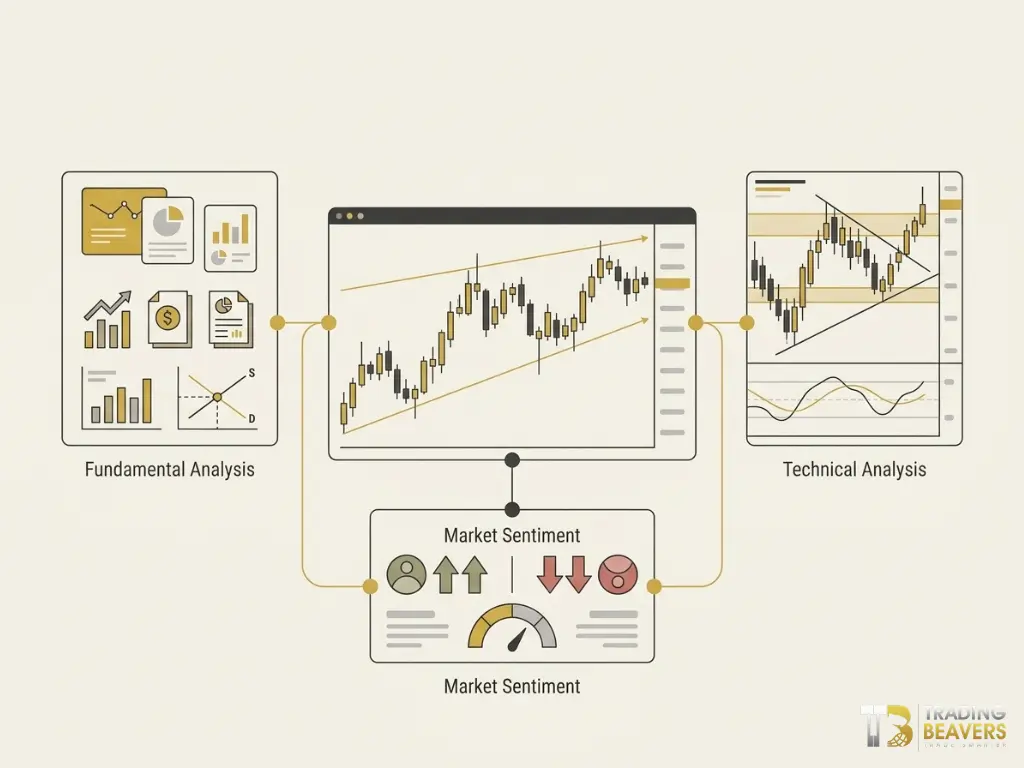
Market analysis methods are generally divided into three main types:
What Is Fundamental Analysis in Trading?
Fundamental analysis examines economic and financial factors that may affect an asset’s value, such as interest rates, inflation, economic data, news, corporate earnings, and supply and demand. It aims to understand why the price may move during the period you’re analyzing.
What Is Technical Analysis in Trading?
Technical analysis is based on studying price action and historical market data to identify trends, levels, and possible scenarios. Beginners often learn about price trends, support and resistance levels, candlestick patterns, momentum, trading volume where available, and technical indicators.
A technical signal doesn’t mean the price will necessarily move in the expected direction. These tools are used to develop a scenario, identify entry and exit points, and manage risk.
What Is Market Sentiment Analysis?
Market sentiment analysis focuses on the attitudes of market participants and whether sentiment leans toward optimism or pessimism, or toward taking or avoiding risk. You can study sentiment through price behavior, the market’s reaction to news, and available trader positioning data or sentiment indicators for the market you follow.
No analytical method or technical indicator can predict market movements accurately at all times. The goal of learning how to analyze the market isn’t to predict the future with certainty, but to develop a structured way to assess probabilities, make trading decisions, and manage risk.

7. Choose a Trading Style That Fits Your Circumstances
A trading style is the approach you use to determine how long to hold a trade, when to enter and exit, how many trades to make, and which type of analysis to use. No single style is right for every trader, so choose one that fits your schedule, experience, and risk tolerance.
By holding period:
- Day trading: Opening and closing trades during the same trading day, usually without holding them overnight.
- Swing trading: Holding trades for several days or weeks to take advantage of medium-term price movements.
- Position trading: Holding positions for longer periods, possibly weeks or months, based on broader trends.
By how trades are selected, using approaches that can be combined with any of the holding periods above:
- Trend following: Trading in the direction of the prevailing trend and trying to benefit from its continuation.
- Range trading: Trading between support and resistance levels when the price moves within a clear range.
- Breakout trading: Entering after the price breaks through an important level, with the expectation that the move will continue beyond the previous range.
Don’t choose a trading style because it’s popular or seems to generate profits faster. Choose one whose rules you can follow consistently and with discipline. For example, if you work full time, swing trading may be easier to manage than day trading.
8. Build a Trading Strategy With Clear Rules
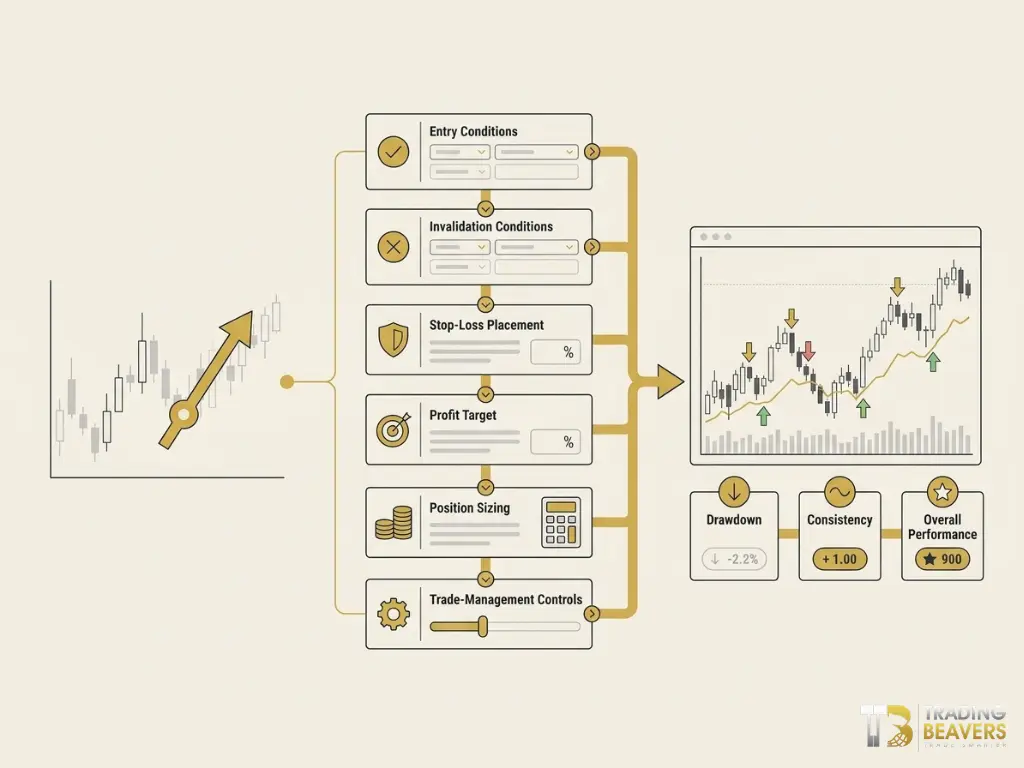
A trading strategy is a set of predefined rules that specify when to enter a trade, when to exit, and how to manage risk while trading. It is more than just a signal from an indicator such as the Relative Strength Index (RSI) or a moving average crossover.
For a strategy to be testable and usable, it must clearly define:
- Market: The asset or market where you will apply the strategy.
- Timeframe: For example, 15 minutes, 1 hour, or 1 day.
- Entry conditions: The signals or conditions that must be met before opening a trade.
- When not to enter: Circumstances that rule out a trade, even if some signals appear.
- Stop-loss: The level at which the trade is closed if the entry idea proves wrong.
- Take-profit: The level or rule used to take profits.
- Position size: The size of the trade relative to your capital and risk.
- Trade management rules: For example, moving the stop-loss order or partially closing a trade if the strategy calls for it.
- Exit conditions: Circumstances in which you close the trade before the stop-loss order or target is reached.
What makes a good trading strategy? It’s not the number of indicators it uses, but whether its rules are clear, repeatable, and testable, and whether it includes risk management alongside entry and exit conditions. Any rule that isn’t clearly defined leaves more room for emotional decisions while trading.
9. Test Your Trading Strategy Before Using It
After building a strategy with clear rules, start with backtesting by applying its rules to historical data. Then use a demo account to test your ability to follow those rules under current market conditions.
Monitor the following during testing:
- Number of trades: To ensure the results are based on a sufficient sample.
- Win rate: The percentage of trades that ended in profit.
- Average profit: The average return from winning trades.
- Average loss: The average loss on losing trades.
- Longest losing streak: The number of consecutive losses the strategy incurred.
- Maximum drawdown: The largest peak-to-trough decline in capital during the testing period.
- Result after costs: Net performance after accounting for the spread, commissions, and financing costs.
The goal at this stage is to see how the strategy performs when its rules are applied across a sufficient number of trades and under different conditions, while keeping in mind that backtesting results do not guarantee future performance.
10. Create a Clear Trading Plan
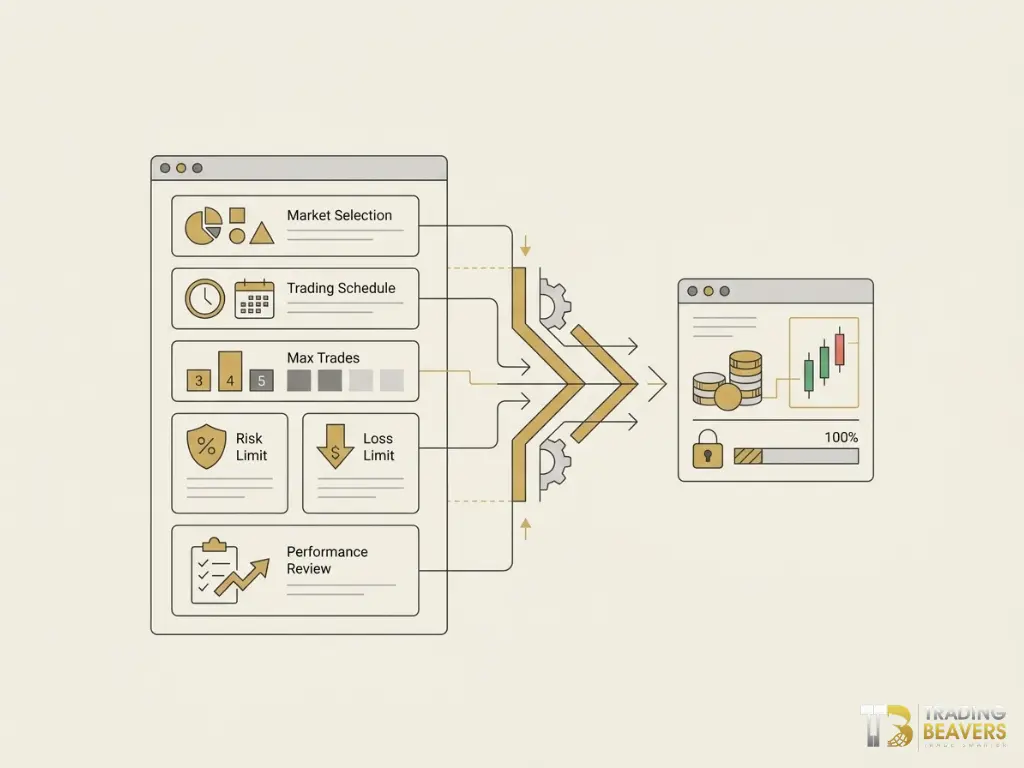
A trading plan is a written framework that sets out how you will manage your market activity overall: when you trade, how much you risk, when you stop, and how you review your performance. A trading strategy sets the entry and exit conditions and how you manage each trade. A trading plan can include:
- Markets you trade: Such as forex, stocks, or gold.
- Trading hours: The periods when you allow yourself to trade.
- Maximum number of trades: To avoid overtrading.
- Maximum daily or weekly loss: The level at which you temporarily stop trading.
- Risk per trade: The amount of capital at risk on each trade.
- Conditions that prevent you from trading: Such as when your strategy’s conditions are not met, volatility increases, or you are making decisions under psychological pressure.
- How to review your results: How you will record trades in a trading journal and periodically review your performance and mistakes.
A written trading plan helps reduce arbitrary decisions and makes trading a more structured process that you can review and improve over time, rather than relying on moment-to-moment reactions to market movements.
11. Move to a Live Account Gradually
Getting good results on a demo account does not mean you are automatically ready to trade with real money. Live trading introduces psychological factors such as fear, greed, and the pressure of real profits and losses. One sign that you are ready to transition gradually is your ability to follow your rules consistently. But discipline alone is not enough; you also need to evaluate your test results after costs and your ability to withstand a loss.
Before moving to a live account, you must be able to:
- Execute orders without getting confused.
- Apply your strategy’s rules consistently.
- Determine your position size before entering a trade.
- Stick to your stop-loss order.
- Accept losing trades without trying to recover the losses through random decisions.
- Record and review your results objectively.
When you start trading with a live account, use capital you can afford to lose without affecting your basic needs or financial obligations, and start with relatively small position sizes. A gradual transition helps you recognize the difference between practicing and making decisions when profits and losses become real.

Which Financial Markets Can You Learn to Trade?
The financial markets you can learn to trade include stocks, forex, commodities, indices, and cryptocurrencies. Each market differs in the type of asset traded, the factors that affect prices, trading hours, and levels of volatility and risk:
| Market | What You Trade | Key Factors Affecting Prices | Trading Hours |
|---|---|---|---|
| Stocks | Shares in publicly listed companies | Earnings, sector, the economy, and interest rates | The trading hours of each exchange |
| Forex | One currency against another in pairs such as EUR/USD | Interest rates, inflation, and central bank decisions | Usually 24 hours a day on business days |
| Commodities | Raw materials such as gold and oil | Supply and demand, production, inventories, and geopolitics | Varies by product and exchange |
| Indices | Products that track an index such as the S&P 500, including futures contracts; you cannot buy the index itself directly | Earnings from major companies, the economy, and interest rates | Tied to exchange hours and may vary by product |
| Cryptocurrencies | Digital assets such as Bitcoin and Ethereum | Supply and demand, adoption, regulation, and project news | Usually 24 hours a day, seven days a week |
Remember that the same market can be traded through different products. For example, buying shares outright differs from trading a CFD on the same stock in terms of ownership, leverage, and costs. Cryptocurrencies are also typically more volatile than many traditional markets and carry risks related to platforms and custody methods.
Once you’ve chosen a market to start with, begin with its detailed guide: What Is Stock Trading?, How Does the Forex Market Work?, or What Is Gold Trading?
What Is the Best Market for Beginners to Trade?
There is no single trading market that is best for all beginners; the most suitable market depends on your capital, the time you have available to monitor it, the level of volatility you can tolerate, and the type of product you want to learn about.
If you prefer studying companies and their results, stocks may be a good fit. If you follow economic news and interest rate decisions, forex may be more relevant to your interests. If you have limited time during the day, pay attention to trading hours and how much you can monitor the market you choose.
In short: Don’t choose a market based only on promises of profits or the size of its price movements. The best market for a beginner is one they can understand and monitor, and whose risks they can manage clearly, not necessarily the most volatile or well-known one.
How Long Does It Take Beginners to Learn to Trade?
There is no fixed timeframe for learning to trade. You can learn the basics, such as placing trades, understanding order types, and using the trading platform, in a relatively short time. But developing the ability to analyze the market, manage risk, and apply a strategy with discipline may take months of study and practice or longer.
How quickly you learn depends on the market you choose, the time you set aside for practice, how regularly you review your trades, and the complexity of the strategy you use.
It’s important to distinguish between learning how to place a trade and developing a measurable trading skill. Knowing where the Buy or Sell button is doesn’t mean you can consistently make good decisions, and no timeframe guarantees proficiency or profitability.
How Do You Choose a Suitable Broker and Trading Platform?
Choosing a broker and trading platform affects the types of products you can access, the costs you will pay, how orders are executed, and the level of protection available for your account.
First, distinguish between the two: a broker is a company that provides a trading account and access to markets or financial products, while a trading platform is the software or app you use to track prices, analyze the market, and execute orders.
The most important things to check:
- Licensing and legal entity: Check the regulator and the entity with which you will open an account.
- Country of residence: Make sure the broker accepts clients from your country and that the available services are suitable for you.
- Costs: Compare spreads, commissions, overnight financing charges or credits (swaps), and deposit and withdrawal fees.
- Trading platform: Choose one that offers the tools you need and suits your experience level.
- Deposits and withdrawals: Review the payment methods, fees, and processing times for requests.
- Demo account: It is useful to try out the trading platform and practice with virtual funds before live trading.
Don’t make leverage or advertising the main factor in choosing a broker. What matters more is licensing, terms of service, costs, execution, and the type of product you get: a real asset or a CFD.
Best Brokers
The following list features several well-known brokers and the minimum deposit amount for each. This is just one criterion for comparison. For a detailed comparison by licensing, costs, and products, see Best Brokers.




What Are the Common Mistakes When Learning to Trade?
The most common beginner mistakes are rushing to use real money, using too much leverage or too many indicators, constantly changing strategies, trying to recover losses quickly, and ignoring costs.
Avoiding these mistakes doesn’t guarantee profits, but it can help you develop a more disciplined approach to learning and decision-making.
1. Starting With Real Money Before Understanding the Basics
Before moving on to live trading, you must understand at least buy and sell orders, stop-loss orders, position size, margin, leverage, and the cost of a trade. A demo account won’t prevent future losses, but it lets you learn these basics without a direct financial loss.
2. Using Too Much Leverage
Leverage increases your market exposure, so it can magnify both profits and losses. But it doesn’t make your analysis more accurate or your strategy better. The larger your position size is relative to your capital, the greater the impact of price action on your account.
3. Trying to Recover Losses Quickly
After losing a trade, a trader may try to increase the position size on the next trade or open additional trades to recoup the money quickly. This behavior is known as revenge trading, and it can lead to emotional decisions and deviations from the trading plan. A previous loss does not make the next trade more likely to succeed.
4. Constantly Changing Your Trading Strategy
If you change your trading rules after every few losing trades, you won’t collect enough data to evaluate the strategy objectively. The result of one trade or even several trades isn’t enough to judge an entire strategy. It’s better to evaluate it over a suitable number of trades and under different market conditions, as we explained in the strategy testing step.
5. Using Too Many Trading Indicators
Combining too many indicators can lead to conflicting signals, delayed decisions, or difficulty understanding the real reason for taking a trade. It’s better to use a limited number of tools whose functions you understand and know how to use as part of your trading plan, rather than adding new indicators whenever the results become unclear.
6. Ignoring Trading Costs or Expecting a Steady Income
A strategy may appear profitable when you consider only price action, but the actual result can change after accounting for the spread, commissions, slippage, and financing costs, especially with frequent trading.
No strategy guarantees a steady income under all market conditions, because performance can change with volatility, liquidity, news, and the market’s own behavior. So always measure performance after costs and over a sufficient number of trades.
Conclusion: How Do You Start Learning to Trade From Scratch?
To start learning to trade from scratch, begin by understanding the market and the product you’ll trade, then learn about orders, costs, and risk management. Next, choose one market, practice in a demo account, build and test a clear strategy, and write a trading plan before gradually moving to trading with real money.
Learning to trade doesn’t mean reaching a point where you never lose; it means knowing why you enter a trade, when to exit, how much you risk, and how to evaluate the results and learn from them. As a first step today, choose one market and read its guide, then write down five new terms you learned from it.
Frequently Asked Questions About Learning to Trade
Can You Learn to Trade for Free?
Yes, you can learn trading for free through educational articles, free courses, and materials offered by some exchanges and educational organizations. You can also use a demo account to practice what you learn without risking real money.
But learning for free doesn’t mean trading itself is cost-free. Live trading may involve the spread, commissions, swaps, and other fees, depending on the market and broker. Be wary of courses or signal channels that promise guaranteed profits.
How Much Money Do You Need to Start Trading?
There is no single amount that’s right for everyone who wants to start trading. The capital you need depends on the market, product type, broker, minimum position size, and the level of risk you can tolerate.
A broker’s minimum deposit shouldn’t automatically be considered the right amount to start with. The most important things are to use money you can afford to lose and choose a position size that aligns with your risk management plan.
Is Trading Profitable?
Trading can generate profits, but it doesn’t guarantee a profit. Results vary based on the strategy, risk management, market conditions, costs, and how closely the trader follows their plan.
A trader may lose some or all of their capital, so trading should be treated as a high-risk financial activity, not a guaranteed source of income.
What’s the Difference Between a Broker and a Trading Platform?
A broker is a company that provides a trading account and access to markets or financial products. A trading platform is the software or app used to display prices, analyze the market, and execute orders.
Can You Learn to Trade Without Losing Money?
You can learn the basics of trading using a demo account without losing real money, but there is no guarantee that you will avoid losses when you move to live trading.
That is why risk management focuses on determining the size of a potential loss and controlling it, not on trying to prevent every losing trade.
Trading Beavers verifies information against reliable sources when preparing its content, primarily data and reports issued by relevant official bodies and companies, when available. We also consult specialist sources and reputable publishers, comparing and verifying information where possible, in line with editorial standards (in Arabic) grounded in neutrality and objectivity.
📌 Disclaimer: This content is for educational and informational purposes only and does not constitute investment advice. Trading involves high risks that may result in the partial or total loss of capital. You should conduct your own research before making any investment decision.