




Top Broker of the Month
Open an Exness account and practice trading with a resettable $10,000 demo — zero risk to your own money.
Stock trading involves buying and selling shares in companies to benefit from changes in their market prices. When you buy a real share in a publicly traded company, you own a small stake in it. You can also trade a stock’s price movements using derivatives such as a contract for difference (CFD) without owning the stock itself.
Stock trading differs from long-term investing in its goals and time frame. Traders typically focus on price changes, entry and exit timing, and risk management, and may hold a trade for minutes, days, weeks, or months, depending on their trading strategy.
If you’re starting from scratch, the terminology may seem overwhelming at first. That’s why this guide explains step by step what a stock is, how its price is determined, the difference between a real share and a CFD, and how to start trading and manage the risks of your trades. You can then explore each topic in more depth through the site’s stock trading lessons.
Table of Contents

What Is a Stock?
A stock or share is a unit of ownership that represents a small stake in a company. When you buy an actual share in a publicly traded company, you become a shareholder, with an ownership percentage determined by the number of shares you own relative to the total shares outstanding.
For example, if a company has 1 million shares outstanding and you own 1,000 shares, you own the equivalent of 0.1% of the company’s outstanding shares.
Depending on the type of share and the rules of the company and market, owning shares may give you certain rights and benefits, such as:
- Benefiting from an increase in the stock’s value if its price rises.
- Receiving dividends if the company decides to pay them.
- Having voting rights in some cases.
- Selling the shares to another investor later in the market.
Owning shares does not guarantee a profit. Their price can rise or fall, and dividends are not guaranteed; they depend on the company’s decisions and financial performance.

How Does the Stock Market Work?
The stock market is a system that brings together buyers and sellers to trade shares in publicly listed companies. Buy and sell orders are executed according to each exchange’s rules and the execution method used.
Some of the best-known stock markets and exchanges around the world include:
- New York Stock Exchange (NYSE).
- Nasdaq.
- London Stock Exchange (LSE).
- Saudi Exchange (Tadawul).
- Other exchanges and financial markets in different countries.
When you open your broker’s platform and click Buy or Sell, your order does not necessarily go directly to another investor. Usually, the trade order is first sent to the brokerage firm, which routes it to the appropriate exchange or execution venue based on the market, stock, order type, and execution method in use.
In simplified terms, the process works as follows:
- The investor chooses the stock they want to buy or sell.
- The trade order is submitted through the broker’s platform.
- The broker receives the order and routes it to the appropriate execution venue.
- The buy order is matched with a compatible sell order when the required price and conditions are met.
- The order is executed and a confirmation appears in the investor’s account. Then settlement takes place, meaning the actual transfer of ownership of the shares and funds. In the U.S. market, most stock trades settle one business day after the execution date (T+1), a system in effect since May 28, 2024.
Execution speed and the final trade price depend on the stock’s liquidity, order type, market conditions, and the bid-ask spread. As a result, a trade may execute at a different price from the one shown when the order was submitted, especially during periods of high volatility.

How Is a Stock’s Price Determined?
A stock’s price is determined by the interaction of supply and demand between buyers and sellers. When demand for a stock increases and buyers are willing to pay higher prices, its price tends to rise. It may fall when selling pressure increases relative to available demand, until the market reaches prices at which buyers and sellers are willing to trade.
What Factors Affect a Stock’s Price?
Supply and demand for stocks change in response to a wide range of factors, including:
- The company’s financial results, profits, and revenue.
- The company’s future growth prospects.
- News and announcements that affect the company’s business.
- Interest rates and monetary policy.
- Economic conditions and inflation.
- The performance of the company’s industry.
- Management decisions and the company’s strategy.
- Mergers and acquisitions.
- Investor sentiment and market trends.
- The stock’s valuation relative to the company’s earnings and growth prospects.
For this reason, a stock’s price reflects not only the company’s past performance, but also investors’ expectations for future earnings, growth, and risks. A company’s stock may rise despite a decline in some of its current results if those results are better than expected. It may also fall despite good results if they come in below market expectations.


How Does Stock Trading Work?
Stock trading involves buying or selling shares based on a trader’s expectations for the price trend, with the aim of benefiting from price changes while managing position size, risk, and costs.
In the simplest form of trading real shares, a trader buys a share at a certain price and then aims to sell it later at a higher price. If the price falls and the trader sells the share for less than the purchase price, the result is a loss rather than a profit.
Hypothetical example: Suppose you buy 10 shares at $100 per share. The following table shows the outcome in two scenarios, before accounting for any commissions, taxes, or other charges that may apply to the trade:
| Scenario | Sale Price | Outcome for 10 Shares Before Costs |
|---|---|---|
| Price rises | $110 | $100 profit ($10 × 10 shares) |
| Price falls | $90 | $100 loss ($10 × 10 shares) |
Profit or loss depends not only on the price trend, but also on the difference between the entry and exit prices, the number of shares, and trading costs. So it’s not enough to predict whether a stock will rise or fall; you also need a plan that sets out when to enter and exit and how much to risk. That’s where risk management becomes important.
What Is the Difference Between Stock Trading and Stock Investing?
The main difference between stock trading and stock investing lies in their goals, time horizons, and decision-making approaches. Traders generally focus on benefiting from price movements over shorter periods, while investors typically focus on a company’s growth and earnings over the long term.
| Factor | Stock Trading | Stock Investing |
|---|---|---|
| Time Horizon | Usually short or medium term | Usually long term |
| Goal | Benefit from price movements | Capital growth and potential income |
| Number of Trades | Usually higher | Usually lower |
| Technical Analysis | Commonly used | May be used to time entry |
| Fundamental Analysis | Important, depending on the strategy | Usually a key component |
| Trading Costs | May recur with frequent trading | Usually less frequent |
| Level of Monitoring | Usually higher | Usually lower |
In practice, traders pay attention to the price trend and momentum, support and resistance levels, market-moving news, and entry and exit timing. Investors focus on revenue and earnings growth, the strength of a company’s financial position, its valuation, and the quality of its management.
However, there are no strict boundaries between the two approaches. Traders may use fundamental analysis to select stocks, while investors may use technical analysis to improve their timing when buying. Ultimately, the distinction comes down to the time horizon, the frequency of buying and selling, and how the position is managed.
What Is the Difference Between Buying Real Shares and Trading Stocks Through CFDs?
The main difference between buying real shares and trading stocks through contracts for difference (CFDs) is ownership. When you buy a real share, you own an actual stake in the company. When you trade a CFD, you trade a derivative contract that tracks the stock’s price movements without owning the underlying share.
So, seeing stocks such as Apple, Tesla, or Amazon on a trading platform doesn’t automatically mean you’re buying real shares; the platform may offer them as CFDs or another derivative product. For example, Exness offers stocks on its official page as CFDs, meaning you trade on the stock’s price action without owning the shares themselves.

What Is a Stock CFD?
A stock CFD is a derivative financial instrument that lets you trade changes in a stock’s price without actually owning it.
When you trade a stock CFD:
- You do not own the underlying shares.
- Your profit or loss is tied to price changes.
- Depending on the broker and regulator, leverage may be available.
- Financing costs may apply when you hold a position for certain periods.
- You don’t necessarily receive the same rights as an actual shareholder.
- Cash adjustments related to dividends may apply instead of receiving the dividend in the same way as an owner of the actual share.
What Is the Difference Between Real Shares and Stock CFDs?
| Feature | Real Share | Stock CFD |
|---|---|---|
| Company ownership | Yes | No |
| Profiting from price changes | Yes | Yes |
| Leverage | Not a standard feature of traditional purchases | May be available |
| Dividends | You may be entitled to them as a shareholder | Cash adjustments may apply |
| Voting rights | May be available | Generally not available |
| Financing costs | Generally do not apply in the same way | May apply |
| Complexity and risk | Relatively simple | Generally higher because of leverage and derivatives |
Can You Profit From a Falling Stock Price?
Yes, through what is known as short selling—selling a stock you do not own in the hope of buying it back later at a lower price. With real shares, this usually involves borrowing the stock through a broker, then buying it back on the market and returning it to the lender. Short selling is generally subject to margin account rules. The U.S. Securities and Exchange Commission (SEC) therefore describes it as a strategy suited to experienced investors.
With CFDs, you can usually open a sell trade directly on the stock’s price without borrowing the stock. In either case, if the price rises instead of falling, you incur a loss. There is no theoretical limit to how high a stock’s price can rise, which makes it especially important to determine your position size and set a stop-loss order before opening a short position.

What Types of Stock Trading Orders Are There?
Stock trading orders are instructions traders send to their broker to specify how to buy or sell a stock. Each order type differs in how it is executed, how much control it gives you over the price, and how it affects risk management.
- Market Order: An order to buy or sell a stock immediately at the best available price. It is usually executed quickly, but does not guarantee the execution price; the final price may differ from the last price shown when you submit the order, especially during rapid price swings or when liquidity is low.
- Limit Order: Lets you specify the price at which you want to buy or sell, or a better price. For example, you can place an order to buy the stock at $95 or less. This order type gives you more control over the price, but execution is not guaranteed if the market does not reach your specified level.
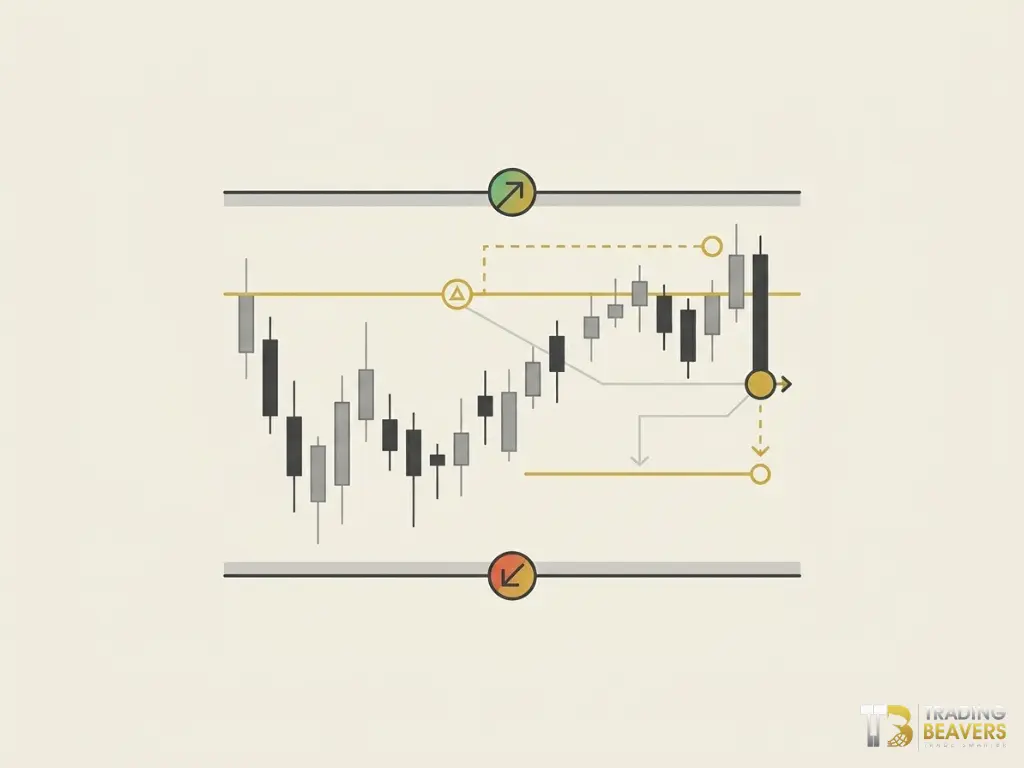
- Stop Order: An order to buy or sell when the price reaches a preset level called the stop price. At that point, it usually becomes a market order. You can use it to enter or exit a trade, depending on your trading strategy.
In practice, these orders are used to decide in advance how to exit a trade:
- Stop-Loss Order: A type of stop order you set to exit a trade if the price moves against your expectations. Because it usually becomes a market order when triggered, it does not guarantee an exit at the stop price itself. Slippage may occur during price gaps or rapid moves.
- Take-Profit Order: An order to close a trade automatically when the price reaches a specified target. It generally works like a limit order and helps you stick to your exit plan rather than make a decision in response to market moves. How both orders are executed depends on the broker and trading platform.
How to Start Stock Trading Step by Step
To start stock trading in a structured way, first define your goal, learn the basics of the market, and choose a suitable broker. Then make a clear plan before placing any trade.
- Decide whether you want to trade or invest: Decide whether your goal is short-term trading, swing trading, or long-term investing. This choice affects your analysis, the number of trades you make, and how closely you monitor them.
- Learn the basics of the stock market: Before using real money, understand concepts such as stocks, exchanges, trading volume, order types, and fees. Key terms include the bid, the highest price buyers are offering, at which you can sell, and the ask, the lowest price sellers are asking, at which you can buy. The difference between them is called the spread. You can start with a list of key stock trading terms for beginners.
- Choose a suitable broker: Check its licensing and legal entity, the markets available, whether you will be buying real shares or CFDs, as well as its fees, order execution methods, and deposit and withdrawal options.
- Open an account and complete the verification process: Depending on the country, product, and applicable regulations, the broker may ask you to provide proof of identity and address, as well as some financial or investment information.
- Determine how much capital is appropriate: There is no single amount that suits all traders, and the minimum deposit is not necessarily an appropriate amount of trading capital. Consider stock prices, the availability of fractional shares, position size, costs, and the level of risk you can tolerate.
- Choose and research a stock: Do not buy a stock just because it is popular, has risen sharply, or is frequently discussed on social media. Understand the company, its sector, its results, its valuation, the stock’s liquidity, its price action, and your reason for entering the trade.
- Plan the trade: Before buying, determine your reason for entering, your entry price, your exit level if the price moves against your expectations, your potential target, your position size, and your maximum acceptable loss. Then compare your potential profit with your potential loss (the risk-reward ratio) after accounting for costs.
- Choose an order type: Decide whether to use a Market Order, Limit Order, or Stop Order, and make sure you understand how each order is executed and the risks involved.
- Execute and manage the trade according to your plan: Avoid changing your decisions in response to every short-term price move. If the underlying reasons for the trade change, reassess it according to clear rules.
- Record the trade and review it: Write down the stock’s name, why you entered, the entry and exit prices, the result, any mistakes, and how closely you followed your plan. Reviewing your trading journal can help you improve your decisions over time.


What Are the Risks of Stock Trading?
Stock trading involves risks that can lead to the loss of some or all of your capital in certain cases. The level of risk varies depending on the type of stock, position size, liquidity, market conditions, and whether you use leverage.
Risk of a Declining Stock Price
The most basic risk in stock trading is that the price may fall after you buy. If you buy a stock and its price falls, the value of your position declines, and you may realize a loss when you sell.
This risk becomes more significant when your position size is large relative to your account or when you enter without a clear exit plan.
Company Risk
A stock’s price may fall because of problems specific to the company, such as declining profits, rising debt, management problems, the failure of a major product, or the loss of a competitive advantage.
In more serious cases, the company may face a financial crisis or bankruptcy, which could lead to significant losses for shareholders.
Market Risk
A strong company’s stock may decline even when there is no direct problem with its business, because the broader market or sector is falling.
Factors such as interest rates, inflation, recessions, financial crises, and geopolitical tensions can affect the prices of many stocks at the same time.
Liquidity Risk
Liquidity describes how easily you can buy or sell a stock without significantly affecting its price. With thinly traded stocks, traders may have difficulty exiting at their preferred price, and the bid-ask spread may also be wider, increasing the cost of executing the trade.
News and Price Gap Risk
Company results, regulatory decisions, or unexpected news can trigger sharp price moves.
In some cases, a stock may open at a price far above or below its previous close, creating a gap. As a result, a stop-loss order may be filled at a different price from the specified level.
Concentration Risk
Putting a large share of your capital into one stock makes your portfolio’s performance more dependent on what happens to that company.
If the company is hit by negative news or its results deteriorate, the impact on your capital may be greater than it would be in a portfolio spread across several investments.
Leverage Risk
Risks increase significantly when you use margin or trade stocks through CFDs, because leverage lets you open a position larger than the capital you actually put in.
This means a relatively small price move can result in a larger profit or loss than trading without leverage.
Psychological Risks
The risks of stock trading are not limited to the market; they can also stem from the trader’s own decisions, as we explain in detail in our guide to The Most Dangerous Psychological Mistakes in Stock Trading. Some of the most common behaviors that can hurt results include:
- Entering a trade out of fear of missing a price move.
- Letting greed drive you to seek profits beyond what your plan calls for.
- Fear that leads to unplanned exits.
- Revenge trading: Trying to recover a loss quickly by placing new trades.
- Overtrading: Placing an excessive number of trades without clear opportunities.
How Do You Manage Stock Trading Risk?
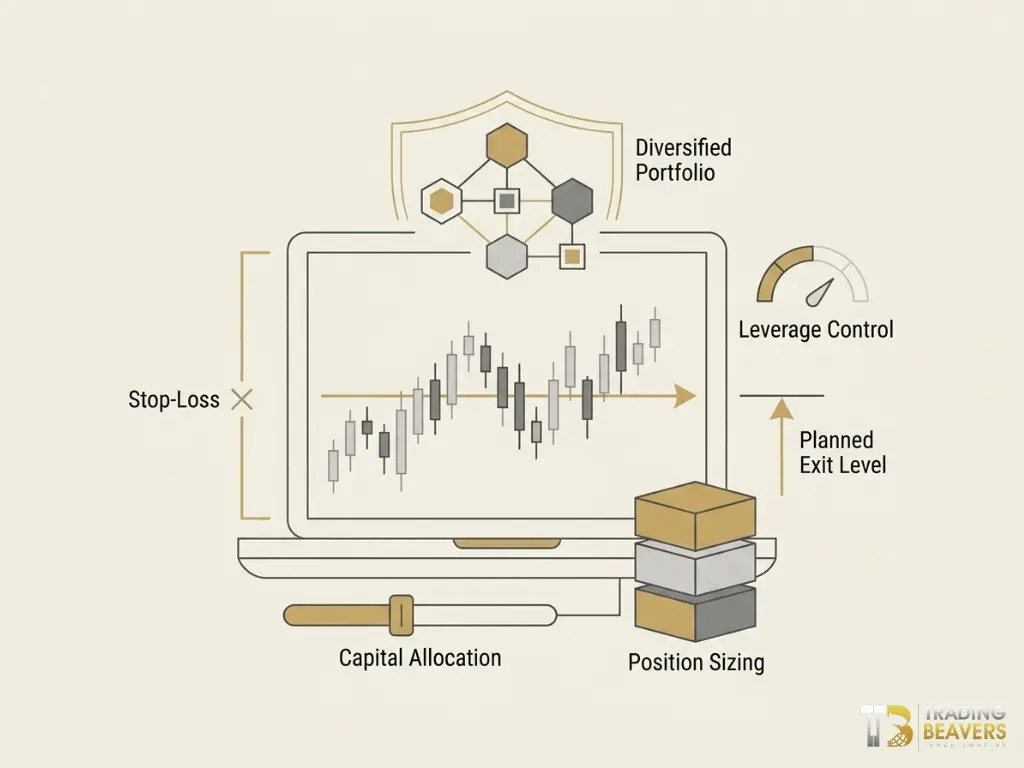
Managing stock trading risk means determining the potential loss before opening a trade, choosing an appropriate position size, and setting clear entry and exit rules instead of relying on predictions alone.
Key Risk Management Rules for Stock Trading:
- Determine the potential loss before entering: Know the price level at which your trade thesis would be invalidated, and how much your account can afford to lose if the price reaches that level. The goal is to limit the impact of a losing trade, not to prevent losses entirely.
- Calculate your position size: Determine the number of shares based on your account size, the amount you are willing to risk, and the distance between the entry price and the stop-loss order. The greater the distance to the stop-loss order, the fewer shares you can buy while risking the same amount.
- There is no one-size-fits-all risk percentage: Some traders use percentages such as 1% or 2% of capital per trade, but these are not rules that work for everyone. Appropriate risk varies with the stock’s volatility, account size, strategy, and number of open positions.
- Check company earnings dates before entering: Volatility may rise around earnings announcements and important news, so it may make sense to reduce your position size or delay entering during these periods.
- Avoid excessive concentration: Diversification can reduce the impact of a problem affecting a single company, but it does not eliminate market risk. Owning a large number of stocks without understanding them does not necessarily mean better risk management.
Hypothetical position size example: Suppose your account balance is $5,000, and you decide not to risk more than 1% on any one trade, or $50. If you buy the stock at $100 and set a stop-loss order at $98, your risk per share is $2. That means the maximum number of shares is $50 ÷ $2 = 25 shares, worth a total of $2,500.
This calculation excludes costs, and the actual loss may exceed $50 if the stock opens with a gap below the stop-loss level. For a step-by-step explanation of this method, see our guide to risk management in stock trading using the 1% rule and stop-loss orders (in Arabic).
How Do You Choose a Stock Broker?
Choosing a stock broker involves more than just fees. Consider factors such as licensing, the types of stocks available, the nature of ownership, execution quality, protection of client funds, and how easy it is to deposit and withdraw money.
The right broker should clearly explain what you are buying, what costs you will pay, and which legal entity will hold your account.
Check the Broker’s License
First, confirm which legal entity will provide the service, then check its license in the official register of the relevant regulator.
It is not enough for the brand to be well known or to display a regulatory body’s logo. Make sure the entity that will hold your account is actually regulated by the named authority, because protections and terms can vary from one country to another.
Does the Broker Offer Actual Shares or CFDs?
As we explained in the section on the difference between real shares and CFDs, seeing a stock on the trading platform does not mean you own it. Before opening an account, check the broker’s list of instruments or contract specifications, because the product type determines ownership, leverage, dividends, costs, and shareholder rights.
Check the Available Exchanges and Markets
The markets offered vary from broker to broker. Some brokers focus on U.S. stocks, while others provide access to European, Asian, or local markets.
First decide which markets you want to trade, then check that the broker offers the stocks and exchanges you actually need.
Check Whether Fractional Shares Are Available
Fractional shares let you buy part of a share instead of a whole share.
This feature can be useful when a stock’s price is high or when you want to spread a small amount of capital across more than one company. However, check the broker’s ownership and execution terms, because the way fractional shares are offered can vary from one firm to another.
Compare Stock Trading Fees
Do not rely on the phrase zero commission alone. Trading may involve other costs even when there is no commission on buying or selling. In particular, check:
- Trading commissions.
- Spreads, if any.
- Currency conversion fees.
- Deposit and withdrawal fees.
- Custody or account management fees, if any.
- Inactivity fees.
- Any financing costs if you use margin or derivative products.
Review Deposits and Withdrawals
Check which deposit and withdrawal methods are available in your country, any fees, minimum or maximum limits, and the usual processing time.
It is also important to review the withdrawal terms before depositing money, because some methods or currencies may be restricted depending on the legal entity or your country of residence.
In summary: When choosing a stock broker, first check its licensing and legal entity. Then make sure you get Real Shares or CFDs, depending on your goals, and compare the available markets, fees, trading platform, and withdrawal methods before opening an account.
Top Stock Brokers
The following list features several well-known brokers and the minimum deposit required by each. This is just one criterion. For a detailed comparison of stock trading platforms, including product types, costs, and available markets, see our guide to choosing a reliable stock trading platform.





Summary: What Should You Know Before Trading Stocks?
Stock trading involves buying and selling company shares or trading products linked to their prices to benefit from price movements. Before placing your first trade, it is important to have a clear understanding of:
- The stock and product you are trading: Are you buying an actual stock or trading a CFD?
- How the market and stock prices work: How does the stock market work, and what role do supply and demand play in price movements?
- Trade execution basics: Understand Bid, Ask, and Spread, as well as order types such as Market, Limit, and Stop.
- Analyzing a stock: Understand the company’s fundamentals, read price action, and know the factors that may affect the stock.
- Trade costs and risks: Know the fees, position size, potential loss, and exit point if the price moves against you.
- The broker and account: Make sure the broker is regulated and understand the account type, product, and trading terms.
- Trading plan: Decide why you are entering and exiting a trade and how you will manage risk before placing it, rather than relying on a forecast alone.
A beginner’s first goal is not to find the stock that will rise tomorrow, but to build a clear decision-making process and manage risk when the forecast is wrong. Start by analyzing one stock in a company whose business you understand, and try writing a trade plan for it in a demo account.

Frequently Asked Questions About Stock Trading
Can You Lose More Than the Amount You Invest in Stock Trading?
When you buy actual shares without using leverage, your loss is generally limited to the amount invested if the share price falls to zero. But using margin or CFDs with leverage, or opening short positions, can increase your losses. In some cases, losses may exceed the amount deposited, depending on the product, the broker’s terms, and whether negative balance protection is available.
How Much Money Do You Need to Start Trading Stocks? Is a Small Amount Enough?
There is no fixed amount that works for everyone. Some brokers may let you start with a small amount, especially if fractional shares are available. But a low minimum to open an account does not mean trading is low risk. The right amount depends on the share price, position size, and fees. Most importantly, use an amount you can afford to lose without affecting your essential needs.
What Happens to My Shares If the Company Goes Bankrupt?
When a company goes bankrupt, holders of common stock are last in line to make claims, after creditors such as bondholders, suppliers, and employees. The U.S. Securities and Exchange Commission (SEC) therefore notes that a bankrupt company’s common stock often becomes worthless, even if the company successfully restructures, because a restructuring plan often cancels existing shares. The process varies depending on the company, the laws, and the market where you trade.
Trading Beavers verifies information when preparing its content by consulting reliable sources, especially data and reports issued by relevant official bodies and companies, when available. We also use specialized sources and publishers with established professional reputations, comparing and verifying information whenever possible in accordance with our editorial standards, which are based on neutrality and objectivity.
📌 Disclaimer: This content is for educational and informational purposes only and does not constitute investment advice. Trading involves high risks that may result in the partial or total loss of capital. You should conduct your own research before making any investment decision.