



Top Broker of the Month
Open an Exness account and practice trading with a resettable $10,000 demo — zero risk to your own money.
No single broker is best for every investor in Nigeria. Choosing the best brokers in Nigeria depends on the market you want to access, the types of assets you want to trade, the costs, the trading platform that suits you, and the regulator that licenses the entity where you plan to open an account.
If your goal is buying Nigerian stocks, start by comparing brokers registered with the Securities and Exchange Commission of Nigeria (SEC Nigeria) that offer trading on the Nigerian Exchange (NGX), and review ownership, custody, and fees.
For international markets, decide whether you want to buy actual shares or trade derivatives on their prices, then check the entity, the scope of its license, and the terms for serving residents of Nigeria. A foreign license held by the group does not establish that your account is covered by it or that the service is authorized locally.
It is important to distinguish between two things: a broker accepting a client who resides in Nigeria does not mean it is licensed in Nigeria, and foreign licensing does not replace the need to verify that the broker has the appropriate authorization to provide services locally.
Need | Recommendation | Action |
|---|---|---|
Easy start & low minimum deposit |  | |
Scalping and automated trading |  | |
Learning before real trading |  | |
Stock investing |  |
Table of Contents
Best Brokers in Nigeria
The reviews below cover each broker’s main strengths and limitations, and the types of traders it may suit, comparing minimum deposits, trading platforms, fees, available assets, and accounts and services that matter to investors and traders in Nigeria. Including a global broker does not mean it is registered with SEC Nigeria or guarantee that your account and funding method will be accepted.
Pros
- Low and competitive spreads.

- Fast withdrawals through most payment methods.
- Supports MT4 and MT5.
Cons
- Does not offer direct trading in US stocks.

- Limited features for small accounts.
Why do we recommend Exness?
Exness is suitable for those looking for an easy start, thanks to its low minimum deposit, fast order execution, and quick withdrawals. It also offers a variety of account types and Islamic trading options to meet the needs of both beginners and experienced traders.
Pros
- Spreads starting from 0.0 pips.
- Fast execution and high liquidity.
- Suitable environment for automated trading and scalping.
Cons
- Minimum deposit is higher than some competitors.
- Arabic-language support is less available compared with some brokers.
Why do we recommend IC Markets?
If you rely on scalping or use automated trading bots, IC Markets is one of the best options thanks to its low trading costs, fast execution, and technical infrastructure designed for active traders.
Pros
- Low minimum deposit.
- Comprehensive educational academy.
- Wide range of account types and financial instruments.
Cons
- Some promotional offers may not be available in all countries.
Why do we recommend XM?
XM is a suitable choice for beginners thanks to its easy account opening process, low minimum deposit, and educational content that helps traders learn the basics before moving on to trading with real money.
Pros
- User-friendly xStation platform with a wide range of tools.
- Access to real stock trading.
- Advanced analysis tools.
Cons
- Available products may vary depending on your country of residence.
Why We Recommend XTB?
XTB stands out for its focus on stock and ETF investing alongside CFD trading. Its user-friendly platform and advanced analytical tools make it a suitable choice for investors who want to build an investment portfolio while also trading.
How Do You Choose the Best Broker in Nigeria?
To choose a broker that suits you in Nigeria, compare three key factors: licensing and client fund protection; total costs and execution quality; and the assets, accounts, and trading platform that suit your approach. Do not choose a broker based only on its lowest minimum deposit or highest leverage.
What Should You Check About Licensing and Client Fund Protection?
Check the regulator’s official register for the name of the company you will contract with, its license number, and the scope of activities it is authorized to conduct. Then review its rules for segregating client funds, its negative balance protection policy, its complaints process, and whether you are eligible for any compensation scheme. Do not assume that every license held by the group or every protection benefit applies to your account.
How Do You Compare Trading Costs and Execution Quality?
Compare the total cost of the instrument you plan to trade, including the spread, commission, position-holding fees, currency conversion charges, and any other fees that apply to your account. Also review the order execution policy; the quoted spread alone is not enough to estimate the cost of a trade.
What Accounts, Trading Platforms, and Customer Service Do You Need?
Make sure the broker accepts residents of Nigeria and offers the instruments, trading platform, and funding methods you need. If you need an account with no overnight fees, review the exemption terms, alternative fees, and eligible instruments. Also compare how easy it is to contact customer support and whether service is available in your preferred language, such as Arabic.
Comparing the Best Brokers in Nigeria
The following table compares the four brokers featured in the reviews by rating, minimum deposit, how to activate an Islamic account, trading platforms, spread, and whether you can buy actual shares. The ratings are editorial estimates based on Trading Beavers’ methodology for evaluating brokers. Low fees or the availability of a naira account do not establish licensing in Nigeria; check the entity and the scope of its services before comparing features.
Comparison | Exness | IC Markets | XM | XTB |
|---|---|---|---|---|
Rating | 4.8/5 | 4.4/5 | 4.3/5 | 4.8/5 |
Min. Deposit | 10$ | 200$ | 5$ | 0$ |
Islamic account | Automatic | On request | On request | On request |
Platforms | MT4, MT5 | MT4, MT5, cTrader | MT4, MT5 | xStation |
Spread | Low and competitive | 0.0 pips | Average | Variable by Asset |
Real stocks | Not available | Not available | Not available | Available |
Best for | Beginners | Scalping & Automated trading | Beginners & education | Stock investing |
Leading Global Brokers and Their Availability to Residents of Nigeria
The following table provides information about some of the global brokers included in the comparison, such as their founding year and reported global client numbers. These figures do not mean that a company is the most widely used in Nigeria or that it is licensed locally. Check whether it accepts residents of Nigeria and which entity you would contract with; do not take the availability of registration as proof of licensing in Nigeria.
Broker | Year Founded | Reported Clients |
|---|---|---|
| 2009 | 20,000,000+ |
| 2002 | 2,500,000+ |
| 2008 | 1,000,000+ |
| 2007 | 200,000+ |
What Is the Difference Between Trading Nigerian Stocks and Trading in Global Markets?
Trading Nigerian stocks means trading shares listed on the NGX through a broker that offers this service, while international markets vary by provider, account, and instrument. Distinguish between buying an actual share and holding it in the investor’s name under the market’s arrangements, and trading a CFD, which does not confer the same ownership.
| Comparison | Trading Stocks on the Nigerian Exchange (NGX) | Trading in Global Markets |
|---|---|---|
| Available markets | Shares of companies listed on the Nigerian Exchange (NGX) | Multiple markets and instruments, depending on the broker and account |
| Nature of ownership | Buying shares and registering ownership according to market procedures | May involve buying actual shares or trading derivatives such as CFDs |
| Regulatory checks | Review the brokerage firm’s licensing and its membership in the exchange | Review the licensing of the entity you contract with and the scope of its services |
| Costs | Trading commissions and fees charged by the broker and the market | Commissions or spreads; financing and currency conversion fees may also apply, depending on the instrument |
| Trading hours | Nigerian Exchange (NGX) trading sessions | Vary by market, instrument, and broker |
How Do You Choose a Brokerage Firm for Trading Nigerian Stocks?
Review SEC Nigeria’s register of operators and the status of NGX trading license holders. Then compare order commissions and custody, data, and transfer fees, as well as how to open a securities account, submit instructions, and monitor your portfolio.
SEC Nigeria is a regulator, NGX is the market, the broker executes orders, and CSCS provides depository, clearing, and settlement services. The CSCS account-opening guide explains the broker’s role and the Clearing House Number (CHN). Do not confuse a trading account with a bank account or a payment app.
Examples of Brokers Approved by the Nigerian Exchange (NGX)
As of October 12, 2026, the NGX status list for trading license holders included 186 institutions marked Active, alongside institutions marked inactive, reclassified, or delisted. The following institutions are examples from the active list to check and compare, not a ranking of the best firms. Active status for local equities does not establish authorization for forex or every global product, and you should check for any updates to an institution’s status.
| Local Broker | Approval Reference | What to Compare |
|---|---|---|
| Stanbic IBTC Stockbrokers Limited | Active on the NGX list as of October 12, 2026 | Compare order fees, services for individual investors, and portfolio tracking. |
| Meristem Stockbrokers Limited | Active on the NGX list as of October 12, 2026 | Review the stock trading platform, custody, securities transfers, and fees. |
| Cardinal Stone Securities Ltd | Active on the NGX list as of October 12, 2026 | Check which entity provides the service, the account agreement, and execution commissions. |
Source: the NGX status list of trading license holders. When you open an account, check the institution’s approval status, the scope of its services, and the legal name in the agreement.
How Can You Verify a Brokerage Firm’s License and Avoid Scams in Nigeria?
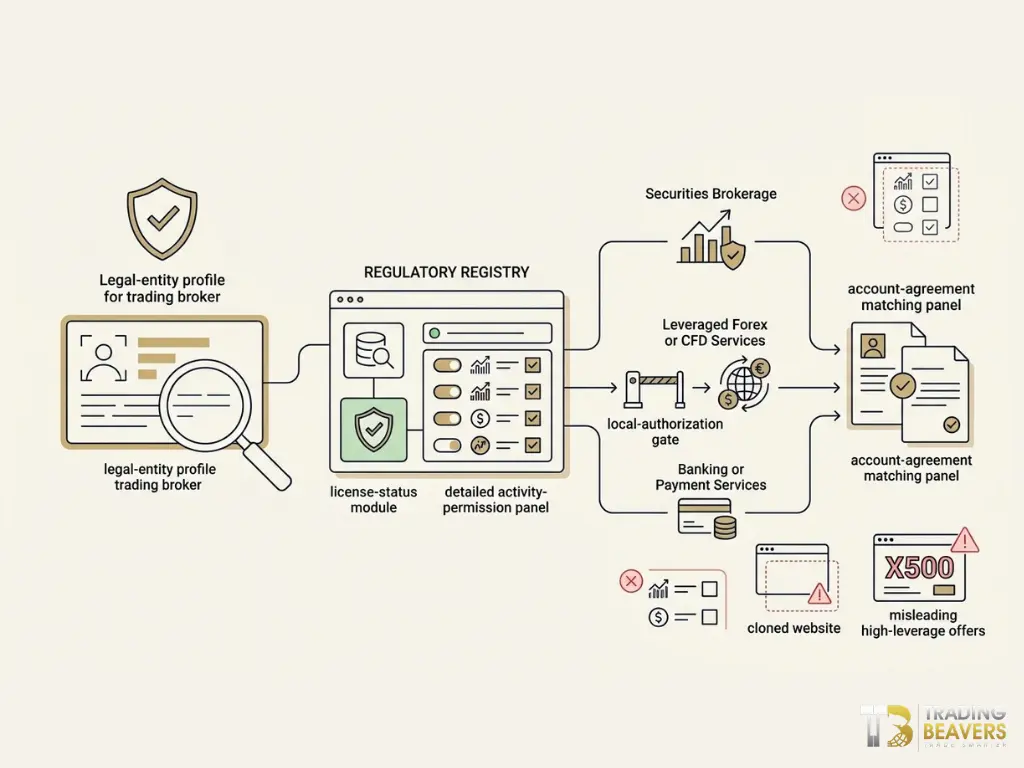
To verify the licensing of a brokerage firm in Nigeria or an international broker that accepts clients from Nigeria, use the company’s legal name as it appears in the client agreement, then compare its license number, status, scope of activities, and website details with the regulator’s official register.
The Investments and Securities Act 2025, enacted in March 2025, repealed the 2007 Act and sets out the Commission’s powers, including registering and regulating exchanges and virtual and digital asset platforms. The Central Bank of Nigeria (CBN) oversees banking, monetary, and payment activities within its remit; a currency exchange license is not a general license for leveraged forex trading.
Do not rely on images of licenses or logos alone, as some fraudulent platforms may impersonate a licensed company or use a website that resembles the official one.
Is Forex Trading Legal in Nigeria?
Do not rely solely on the Commission’s October 2018 warning to conclude that online forex is unregulated. Section 3 of the 2025 Act tasks the Commission with registering and regulating online forex activities, platforms, and brokers, and the Commission has confirmed that conducting this activity without registering with it is a violation. Check the entity’s registration and the scope of its services before funding an account.
According to Nairametrics, on September 1, 2026, the Commission published draft rules for licensing forex and CFD brokers. The draft proposes a minimum capital requirement of 3 billion naira for market-making brokers and leverage limits for retail clients, such as 1:400 for major currency pairs. The draft is open for comment and is not yet in force; check the final version and effective date with the Commission before relying on any leverage limit or new license category.
A local marketing or customer support office, or acceptance of naira transfers, does not replace the need to verify that the company is authorized to conduct the activity. For a foreign account, compare the entity named in the agreement with its regulatory record and check the scope of protection; do not assume that the protections of a European company apply to another company in the group.
How Can You Identify the Regulator Overseeing Your Account?
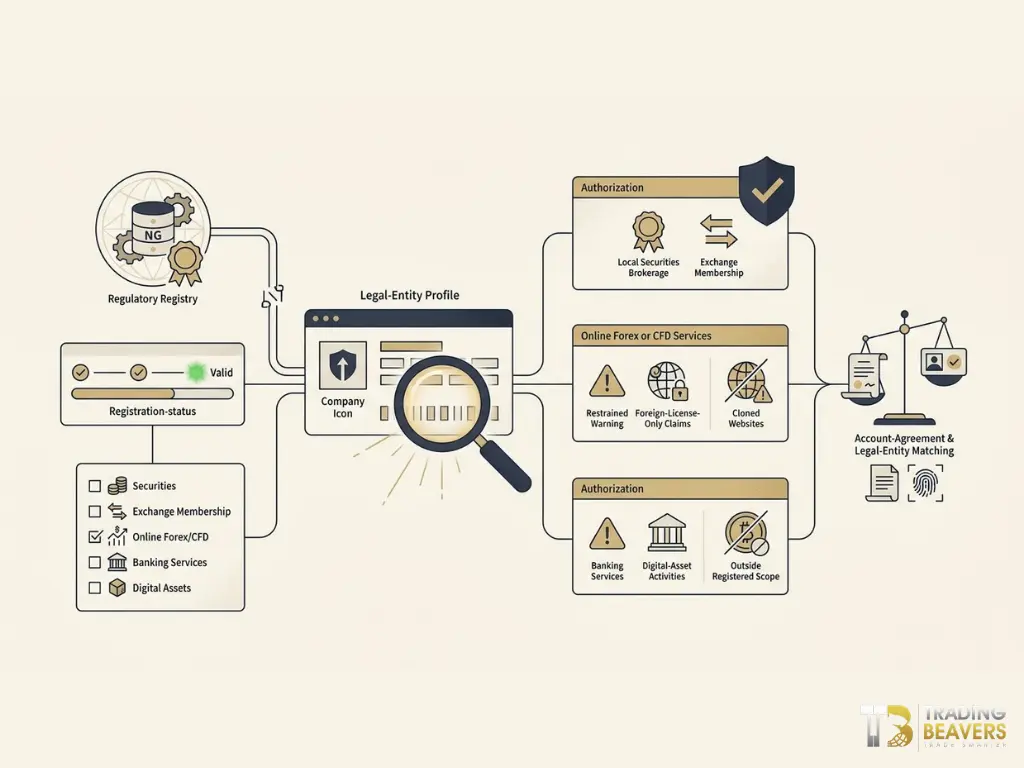
Start with the legal entity named in the client agreement, then look it up in the official register of the regulator cited there. Compare the license status, scope of activities, website details, and contact information; do not rely only on the brand name or regulatory logos.
Search for the legal name in the SEC Nigeria register, and review the registered activities, the institution’s status, and its contact details. Then check its NGX membership if you want to trade local stocks. Commercial registration alone or a foreign regulator’s logo does not establish authorization to broker the product you want.
What Are the Signs of Trading Scams in Nigeria?
Fraudulent trading platforms may use the names of real companies or regulatory logos to persuade investors to transfer money. So do not rely on an advertisement or an image of a license alone, and watch for the following behavior before sharing your information or making any transfer.
- Guaranteed profits or denial of losses: Promises of high, guaranteed returns from trading are a warning sign, especially when they are used to persuade you to increase your deposit.
- Pressure to transfer money quickly: Repeated calls or offers with short deadlines designed to keep you from reviewing the company and its terms.
- Impersonating a well-known company or person: Using a website that resembles the official one or a fabricated promotional video. Verify the web address and contact information through an official source independent of the advertisement.
- Unverified payment instructions: Asking you to transfer money to a personal account or an entity whose relationship to the broker is unclear, without official documentation explaining its role.
- Requesting extra money to release a withdrawal: Requiring a new transfer labeled as a tax to release profits or a fee to lift a freeze, with no verifiable basis. Do not pay before independently verifying the request.
- Requesting access to your account or device: Asking for your password or verification code, or asking you to install remote-access software under the pretext of helping you trade or recover your money.
If you suspect fraud, stop any further transfers and contact your bank or payment provider immediately. Keep your messages, receipts, and the website address, and contact the police and the relevant regulator as appropriate. Filing a report does not guarantee that you will recover your money. For steps to protect your account before and after you deposit, see the guide to protecting yourself from scam forex brokers.
What Are the Best Trading Platforms and Apps in Nigeria?
There is no single trading platform that is best for every user in Nigeria; the right choice depends on the markets you trade, the order types and tools you need, and the device you use.
You should distinguish between a trading platform and a brokerage firm; a broker may provide its own app or offer an external platform such as MetaTrader. So judging the app’s appearance is not enough; also check the broker’s licensing, account fees, order execution policy, and available assets.
What Should You Compare Across Trading Apps in Nigeria?
When comparing trading apps, try the tasks you’ll perform every day on your phone, then evaluate the app using these criteria:
- Order execution clarity: How easy it is to set the position size, review its details, and add or modify stop-loss and take-profit orders.
- Account information: How clearly the balance, used margin, fees, and transaction history are displayed.
- Monitoring and analysis tools: Availability of the charts, indicators, and price alerts you need, and how easy they are to use on a phone.
- Stability and ease of use: Use a demo account on your device to test navigation and position monitoring, keeping in mind that this experience does not establish the quality of execution on a live account.
What Is the Difference Between Third-Party Platforms and Broker Apps?
A broker may offer a third-party platform that you connect to your trading account, or its own app combining some trading and account management features. The same platform being available through two brokers does not mean their tools, fees, or execution terms are identical; check those details with each broker.
For local stocks, compare broker apps by order execution, portfolio and statement displays, data fees, and customer support. Make sure your trading account is linked to the appropriate securities records; a payment or price-quote app does not establish that stock brokerage services are available.
What Are the Terms and Fees for Islamic Accounts in Nigeria?
When choosing an Islamic trading account in Nigeria, do not rely on the “Islamic” or “Swap-Free” label alone. Check which instruments are covered by the exemption, how long it lasts, whether any administrative or holding fees begin after a set period, and the conditions for activating the account and remaining eligible.
Waiving overnight fees addresses only one aspect of a transaction; a Sharia assessment may also require reviewing the nature of the contract, ownership and possession, leverage, and the settlement mechanism. For a detailed guide to comparing these accounts, see our guide to choosing an Islamic forex trading account.
What Should You Review Before Opening an Islamic Trading Account in Nigeria?
- Instruments covered: Check that the exemption applies to the assets you plan to trade, not just to the account’s name.
- Exemption period: Check whether there is a grace period and when any fees begin to apply to open positions.
- Alternative fees: Request a fee schedule that explains how fees are calculated and when they apply, along with the usual spread and commissions.
- Activation and ongoing eligibility: Check whether the exemption is automatic or requires an application and documents, and under what circumstances it can be changed or canceled.
- Nature of the transaction: Determine whether you are buying the asset outright or trading a derivative contract, and review the financing and settlement arrangements; an exemption from overnight fees does not describe every aspect of the trade.
Does a Swap-Free Account Mean Trading Is Halal?
No. Describing an account as swap-free primarily means that specific overnight fees are not applied under the broker’s terms. That alone is not enough to determine whether all transactions comply with Sharia. You should also assess the contract, the asset, ownership and possession, leverage, and the settlement method.
To learn about stock classifications, see our guide to the Sharia ruling on trading pure, mixed, and prohibited stocks.

What Are the Best Brokers Offering Islamic Accounts in Nigeria?
The following table compares how the four brokers activate Islamic accounts and whether they charge overnight fees, as well as the type of trader each broker may suit, based on what the firms disclose. Before opening an account, check each broker’s terms for the instruments covered by the exemption, how long it lasts, and any alternative fees. The account’s trade name does not establish licensing in Nigeria or mean that all the broker’s products comply with Sharia.
Feature | | | | |
|---|---|---|---|---|
Islamic account | Automatic | On request | On request | On request |
Swap fees | None | Vary by instrument | None | Apply to some instruments |
Best for | All traders | Stock investing | Beginners | Experienced traders |
What Markets and Financial Instruments Are Available to Traders in Nigeria?
Available instruments depend on the institution’s licensing, the markets, and the account. The following sections explain how the products differ; they do not imply that every global offering is available or approved for residents of Nigeria.
Before placing a trade, check whether you are buying the asset outright or trading a CFD on its price; do not rely on the stock’s name appearing on the platform alone.
Buying Stocks and Funds or Trading CFDs?
When you buy actual shares, you own the shares, which are held in custody under the broker’s arrangements. When you buy units in an exchange-traded fund (ETF), you own units in the fund. The degree of diversification and the risks vary depending on the assets it invests in.
By contrast, stock CFDs let you trade price movements without owning the underlying stock. Compare the two options in terms of ownership, fees, financing, and whether you can transfer the assets to another broker. Do not rely on similar product names on the platform.
If your goal is to buy and hold stocks, make sure the account supports actual shares. For an explanation of order basics and ownership, see the guide to stock trading for beginners.
Trading Forex, Gold, Commodities, and Indices in Nigeria
When comparing trading in forex, gold, commodities, and indices, check the type of contract the broker offers and its terms. If the product is a CFD on gold or oil, for example, you are trading price movements without owning the metal or commodity.
Buying physical gold is different from buying an ETF or trading a CFD on its price. The list of products traded on the NGX includes the NewGold ETF (ticker: NEWGOLD). Check the fund’s prospectus, liquidity, fees, and availability through your broker. Owning a unit in a fund does not mean you receive a gold bar, and CFDs involve margin and counterparty risks.
To understand the options for gaining exposure to gold before choosing a broker, see our guide to ways to trade and invest in gold.
Can You Trade Cryptocurrencies From Nigeria?
This guide does not present USDT or peer-to-peer trading as a way to get around transfer restrictions from Nigeria. Distinguish investing in a digital asset from using it to fund a broker; acceptance of a transfer does not establish that a platform is approved or that funds are protected.
In December 2023, the Central Bank of Nigeria issued guidelines for banks operating accounts for virtual asset service providers under specific conditions, while continuing to prohibit banks from holding or trading virtual currencies on their own account. It is therefore not accurate to reduce the situation to either an ongoing blanket banking ban or approval of every platform and transaction.
The Commission’s page for fintech operators lists Busha Digital Limited and Quidax Technologies Limited as digital asset exchanges participating in the Accelerated Regulatory Incubation Program (ARIP). Distinguish participation in the program or preliminary approval from a final license and its scope, and check the latest status before opening an account.
Determine whether you are buying an asset you can withdraw or trading a derivative on its price, then review custody, fees, account security, and transfer terms. The popularity of a P2P service or its use through a payment app does not establish that every transaction is suitable or compliant.
What Are the Risks of Leverage and Margin in Trading?
Leverage lets you control a trading position larger than the amount required as margin. As a result, it magnifies the effect of price movements on your account, whether they work for or against you.
Leverage and margin requirements vary by broker, legal entity, account type, asset, and client classification, so there is no single ratio that applies to all traders in Nigeria. For a detailed explanation of how leverage works and how to calculate margin, see the guide to leverage in forex trading.
A simplified hypothetical example for a dollar-denominated account: If you open a $10,000 position with 1:100 leverage, the initial margin could be $100. A 1% price move against you would mean a theoretical loss of about $100 before the spread, commissions, and slippage—equal to the entire initial margin in this example. This example does not establish that this leverage or product is available in Nigeria.
But initial margin is not a maximum loss. The actual trade outcome may vary because of market movements, forced-closeout rules, and price gaps. Protection against a negative balance also varies by entity and account.
Therefore, before using leverage, review the margin requirements, forced-closeout level, and position size, and determine how much of a loss you can tolerate rather than choosing a broker based on the highest available leverage.

A stop-loss order can help manage risk, but a standard order does not guarantee execution at the requested price during gaps or rapid market moves. Separately confirm whether protection against a negative balance applies to your account. It is different from a stop-loss order and does not prevent you from losing your trading balance.
How Do You Choose a Forex Broker That Accepts Clients From Nigeria?
When comparing forex services available to residents of Nigeria, start with the entity’s name, its registration with the Commission, the scope of its activities, and the current status of local rules. Then compare costs, execution, margin, and the trading platform; do not treat high leverage or easy deposits as a substitute for regulatory checks.
If you rely on MT4, MT5, or automated trading, check that the platform supports the tools or Expert Advisors you need before opening an account.
Also review overnight fees or the terms of a Swap-Free account, along with the deposit and withdrawal methods available to you. A broker’s acceptance of residents of Nigeria does not necessarily mean it holds a Nigerian license.

How Do You Open a Trading Account From Nigeria, Step by Step?
The steps for opening a trading account from Nigeria begin with choosing a product and market: NGX stocks, international stocks, or derivatives. Eligibility requirements, documents, custody, and funding vary by service and institution.
How Do You Open an Account With an International Broker From Nigeria?
- Choose the broker and account: Check whether the broker accepts residents of Nigeria, which entity will provide your service, the assets it offers, its fees, and its platform.
- Register and verify your identity: Enter your personal details and provide identity and address documents, along with any required financial or tax information.
- Review the account terms: Check the product types, leverage, fees, and trading terms, and use the demo account if one is available.
- Fund the account: First, check with your bank whether a transfer for this purpose to the account is permitted under foreign exchange rules. Then use an eligible payment method in your name and review the fees and withdrawal policy.
How Do You Open an Account to Trade Nigerian Stocks?
For local stocks, choose a licensed broker and open an investment account and a securities account according to its procedures. CSCS guidance says that anyone with an existing CHN should provide it to the broker when opening a new CSCS account, and that you can hold more than one CSCS account while keeping a single CHN.
Prepare the identity document, address details, bank account information, and financial and tax information the broker requests. Verification requirements may include national identity details or bank verification, depending on your circumstances; ask for a checklist that applies to you as a citizen, foreign resident, or nonresident.
Review the account agreement, execution commissions, custody and transfer fees, data fees, and any applicable minimums. Confirm the procedures for placing buy and sell orders, receiving statements, updating your details, and receiving distributions.
Do not assume that an account with a global broker gives you access to Nigerian stocks, or that an NGX account includes foreign markets. Before funding the account, confirm which market it covers, how shares are owned and held in custody, and whether they can be transferred.

Before opening a local account: Verify the entity and its activities with the Commission and its status with the NGX, and review the CSCS arrangements and fees. Use the institution’s official channels and keep the account agreement and proof of funding.
What Deposit and Withdrawal Methods Are Available for Trading Accounts in Nigeria?
Deposit and withdrawal methods from Nigeria vary by institution, currency, account, and bank policy. Distinguish funding a local stock account in naira from converting currency for an overseas investment account, and confirm that the purpose and payment method are accepted before sending money.
Request the official beneficiary details, then compare bank fees, currency conversion costs, processing time, and the withdrawal policy. International card limits and acceptance may vary by bank; do not assume that a transaction accepted by one bank will work with every bank or account.
Do not assume that OPay, PalmPay, Flutterwave, Skrill, or Neteller accepts deposits for every broker. Use the methods listed for your account that comply with the payment provider’s terms, and do not use someone else’s account or buy USDT to get around a rejection.
| Payment Method | What Should You Check? |
|---|---|
| Bank transfer | Whether the transfer is permitted for investment purposes and what documentation is required, as well as the beneficiary details, currency, fees, and time for the funds to arrive |
| Bank cards | Whether the card can be used to fund the account, transaction limits, currency-related fees, and refund rules |
| E-wallets | The wallet’s regulatory status and whether it can be used for investment transfers, as well as verification requirements and fees; do not use virtual assets |
The withdrawal processing time is not necessarily the time it takes for the funds to arrive. The published time may refer to how long the broker needs to approve the request; the bank or payment provider may then need additional time to deposit the money into your account.
Always follow the funding instructions shown on the official website or in the official client area, and do not transfer money to a personal account or to an entity whose relationship with the broker is unclear.
Are Trading Profits Taxed in Nigeria?
The tax framework changed with the Nigeria Tax Act 2025, published in the official gazette in June 2025 and effective from January 1, 2026. The Act includes provisions on individual income and gains from the disposal of assets, and requires profits or gains from digital asset transactions to be included in taxable income. It is therefore not accurate to apply a flat 10% to all forex profits or carry old tax brackets over to all trading in 2026; the treatment depends on the type of income, the investor’s status, and any applicable exemptions.
Check with the relevant tax authority based on your residency and account status, taking into account the role of state revenue authorities and the Nigeria Revenue Service (NRS). Separate gains on sales from distributions and interest, and keep trading statements and transfer records. Small profits, no withholding, or using a foreign broker do not establish that you are exempt from filing a return or paying tax.
Foreign investments may be subject to withholding or tax obligations in the country of origin, and tax residency outside Nigeria may also affect your obligations. Check the treatment that applies to your circumstances and the assets you own before assuming that a full exemption applies.
Frequently Asked Questions About the Best Brokers in Nigeria
What Is the Best Broker for Beginners in Nigeria?
For a beginner, the best choice is a broker that offers access to the market you want, is appropriately licensed, charges clear fees, provides an easy-to-use platform, and offers a demo account if available. First decide whether you want to buy actual shares or trade CFDs; the two services differ in ownership and risk.
How Can I Make Sure a Broker Is Licensed in Nigeria?
Search the register of the Securities and Exchange Commission of Nigeria by legal name and check the activity, status, and contact details. For local stocks, also check the institution’s status with the Nigerian Exchange (NGX). Commercial registration or the ability to register online is not enough to establish that a product is authorized.
Must a Forex Broker Be Registered With the SEC in Nigeria?
Yes. The Investments and Securities Act 2025 tasks the Securities and Exchange Commission of Nigeria with registering and regulating online forex activities, platforms, and brokers, and the Commission has confirmed that conducting this activity without registering with it is a violation. In September 2026, the Commission proposed detailed draft rules for forex and CFDs that are not yet in force. Check the entity and its registration status before depositing funds.
What Is the Minimum Amount Required to Open a Trading Account in Nigeria?
The minimum varies by broker, account, and deposit method. Check the account’s actual terms: the advertised minimum deposit may differ from the amount needed to buy an asset or cover the margin for a trade, and it does not determine how much is appropriate for you.
What Is the Best Broker for Trading Nigerian Stocks?
Compare local brokers such as Stanbic IBTC Stockbrokers, Meristem Stockbrokers, and Cardinal Stone Securities, which were listed as active on the Nigerian Exchange (NGX) list as of October 12, 2026, among 186 active institutions. Check the latest update and compare fees, custody, and the trading platform. These are examples to check and compare, not a ranking of the best firms.
Is an Islamic Account Free of All Fees?
No. An account may waive specific overnight fees while still charging a spread and commissions, or applying administrative fees under the broker’s terms. The Swap-Free label alone is also not enough to determine whether all transactions comply with Sharia.
Does an International Broker’s License Mean My Account Is Licensed in Nigeria?
No. Accepting a client from Nigeria or having another company in the group hold a foreign license does not establish that the account is registered locally. Check the entity and its activity in the official registers, and find out which authority handles complaints and protection.
Is Cryptocurrency Trading Allowed in Nigeria?
There is no blanket banking ban on all digital asset activities in Nigeria. Central Bank of Nigeria guidelines allow banks to provide accounts to virtual asset service providers under specific conditions, while digital asset platforms and service providers are regulated by the Securities and Exchange Commission of Nigeria. Distinguish participation in the ARIP program or preliminary approval from a final license, and check the platform’s current status before using it.
Trading Beavers bases its content on verifying information against reliable sources, primarily data and reports issued by official bodies and relevant companies when available. We also use specialized sources and publishers with established professional reputations, comparing and verifying information as far as possible in accordance with editorial standards based on impartiality and objectivity.
- Find a Registered Operator – Securities and Exchange Commission of Nigeria (SEC Nigeria)
- Status of Trading License Holders – Nigerian Exchange (NGX)
- Investor Account Opening Procedures – Central Securities Clearing System (CSCS)
- Investments and Securities Act 2025 – Securities and Exchange Commission of Nigeria (SEC Nigeria)
- Public Notice on Online Retail Forex Trading (2018) – Securities and Exchange Commission of Nigeria (SEC Nigeria)
- SEC Proposes Minimum Capital for Forex Brokers and Trading Platforms – Nairametrics
- Guidelines on Operations of Bank Accounts for Virtual Asset Service Providers – Central Bank of Nigeria (CBN)
- Fintech Operators and Incubation Program Participants – Securities and Exchange Commission of Nigeria (SEC Nigeria)
- Listed Exchange-Traded Products – Nigerian Exchange (NGX)
- Nigeria Tax Act 2025 – National Assembly of Nigeria
- Nigeria Revenue Service (NRS)
📌 Disclaimer: This content is for educational and informational purposes only and does not constitute investment advice. Trading involves high risks that may result in the partial or total loss of capital. You should conduct your own research before making any investment decision.